14 of My Favorite Traditional Hungarian Restaurants in Budapest

Hungarian food: a reflection of local climate and traditions, as well as Austrian, Ottoman, Slavic, Jewish, and Romanian influences. While the importance of the goulash hasn't diminished since Hungarian herdsmen cooked it in cast-iron pots hundreds of years ago – although the ingredients did change – new dishes have entered the culinary mainstream along the way. The restaurants below serve reliable dishes along the lines of paprikash, pörkölt, schnitzel, stuffed cabbage, túrógombóc (cottage cheese dumplings), palacsinta and so on.
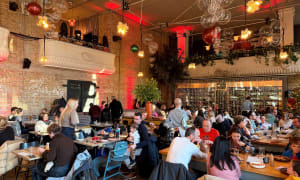
#1 Kiosk

When I'm asked to recommend a fashionable restaurant, something hot and buzzy but also excellent, I often direct people to Kiosk, which specializes in updated Hungarian dishes. Kiosk has remained popular for more than a decade now thanks to a combination of solid food, panoramic location, and not unreasonable price points (the restaurant is also known for its active charitable work of feeding the city's homeless).

Kiosk's outdoor patio overlooks the Danube, the Elisabeth Bridge, and the neighboring Gothic-Baroque church, while the inside has a dramatically high-ceilinged, industrial-chic interior – the former gym of the prestigious high school of the Piarist teaching order that still occupies the rest of this historical building.

Kiosk aims to please all tastes with a diverse menu but the focus is Hungarian food. I especially like the goulash soup; the truffle-infused creamy egg noodles in the chicken paprikash; the seasonal vegetable stew (főzelék) variations; the schnitzel; and the updated mákosguba, a traditional bread pudding dessert soaked in vanilla custard and laced with poppy seeds. The proximity of Babel, a Michelin-starred dining temple next door and run by the same owner, helps ensure that the dishes are on point. €12-16 mains, advance booking a must.

#2 Gettó Gulyás

Gettó Gulyás is a cozy Hungarian restaurant inside Budapest's fashionable Jewish Quarter. The short menu features the heart of Hungarian cuisine, with many dishes imparting the sweet-sharp flavor of fresh paprika: goulash soup; Hortobágyi palacsinta; chicken, veal, catfish and mushroom paprikash; pörkölt with tarhonya. Pickled veggies (savanyúság) on the side, please.

During a recent meal with my parents, we also enjoyed the bone marrow with toast – the bread is sourced from the excellent arán bakery down the street on Wesselényi utca. The specialty of the house is the túrógombóc: pillowy cottage cheese dumplings buried in sour cream and sprinkled with powdered sugar. Hungarian wines are available for pairing.

"Gettó" refers to the Jewish ghetto which this neighborhood became during the winter of 1944; hence the Jewish-Hungarian dishes such as the “Jewish egg” spread which was traditionally an appetizer during Shabbat meals. Advance reservation is an absolute must; forget about scoring a same-day booking. After your meal, you could grab a drink at Szimpla Kert, the mother of all ruin bars just steps away in Kazinczy utca.

#3 Szaletly

Located a bit outside downtown, near the City Park, Szaletly is a casually elegant restaurant worth trekking out to (reachable in 15 minutes by public transport). At least if you are curious to experience what traditional Hungarian food in 2025 might mean. Overseen by head-chef Dániel Bernát, the whole menu is a celebration of dishes that people in Hungary are used to eating, but hardly what appears on most dining tables at home.

There's of course a bowl of goulash, but also the local fish soup (halászlé), foie gras, fogas (pike-perch), layered potatoes with Mangalica (rakott krumpli), schnitzel, and túrós palacsinta (túró-filled crepes). And Stefánia vagdalt: a “meatloaf” named after Stéphanie, the Habsburg Crown Princess of Austria (1864-1945), whose name is borne by the elegant street along which Szaletly is located. I recommend you not leave without a dessert order of somlói galuska or mákos guba, the latter a traditional poppy seeds bread pudding. Also here: a full wine list of Hungarian options and local craft beers by the bottle. €15-22 mains, reservations recommended.

#4 Menza Restaurant

Few locals would dispute the claim that during the past two decades, Menza has been one of Budapest's most reliably excellent restaurants. This perennially buzzing establishment along Liszt Ferenc tér in District 6 churns out traditional Hungarian dishes with a level of consistency that would make any Hungarian grandmother blush. As the night progresses, the music gets louder, the dining room dimmer, the vibes cooler.

I usually start with the meat broth soup (húsleves), followed by the tender pork schnitzel, or the hearty veal paprikash with egg dumplings. Menza's desserts are famously good, such as the poppy seeds-blanketed mákos guba, the somlói galuska, and the Kaiserschmarrn, the latter a Habsburg-era shredded pancake topped with apricot jam. Mains are €12-18. The service staff is among the best in Budapest – informed, kind, and efficient. Reservations are an absolute must.

#5 Café Kör

Ten years ago, when I had an office job in Budapest, my colleagues and I had a steady routine: on Fridays, we ate lunch at Cafe Kör. We liked the restaurant’s traditional dishes and friendly atmosphere. Over time, we got to be treated as regulars by Kör’s ever-present manager, Gábor Molnár, who would greet us with a hearty handshake, show us to our table, and recommend some of the specials that were written on a sheet of paper clipped to the wall.

My colleagues usually went for the outsize schnitzel with a side of salad; I’d opt for a seasonal vegetable stew – főzelék – with meatballs. In the summer, we all started with the sour cherry soup. Solid, reliable classics prepared without culinary acrobatics. By then, Kör had long been an iconic downtown establishment known for its tightly packed tables, bentwood Thonet chairs, and attentive service. It had escaped the fate of longtime restaurants – Kör opened in 1995 – that become petrified or morph into touristy spots (reasonable prices and the owner’s presence help).

People often describe Kör’s atmosphere as “pre-war” or “peacetime” which I understand but find awkward (in Vienna, where there was no Communism to eradicate such typically middle-class establishments, they are simply a “Gasthaus” without the need to elaborate). I left my job in 2016 and my Kör visits became less frequent. But when I return, as I did recently for a stuffed paprika and somlói galuska, my spirits lift a little. Gábor is still there, as is Szilvi who oversees the dining room. The crowd is still a blend: financial-district employees, Hungarian families, tourists with a good nose. Here, just a note of gratitude. Booking via phone (+36 1 311 0053); €12-18 mains; closed on Sunday.

#6 Stand25 Bistro

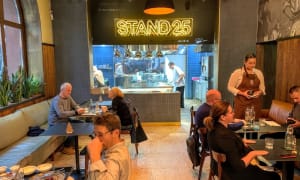
When in 2017 Szabina Szulló and Tamás Széll, the latter a European Bocuse d'Or winner and celebrity-chef in Hungary, announced they were leaving their Michelin-starred restaurant to venture out on their own, one didn’t need a business degree to predict success. The concept of Stand25 was to prove that traditional Hungarian fare can be more than the gut-busting, high-carb, greasy affair this country got used to during the Communist period (1948-1989) and well past that.

Indeed, the restaurant's success was immediate: a well-off local crowd fills Stand25's tables every day for lunch and dinner. Stand25 doesn’t so much reinterpret the classics as it elevates them. The paprika-hued goulash soup arrives with tender cubes of beef nicely crusted through the Maillard reaction. The sharp taste of the paprika is brightened with chopped celery roots, celery leaves, and hints of lemon peel.

The Jókai bean soup, the catfish paprikash, the wild boar stew and the other dishes receive similarly focused attention. Stand’s other claim to fame is the sweet noodle plates that people in Hungary – and the former Habsburg crown lands – eat after a hefty soup or as a dessert. I’m thinking of the túrógombóc, fresh curd cheese dumplings anointed with sour cream and cherry preserves; the diamond-shaped potato dumplings coated in butter and sugary ground walnuts (diós nudli); the rolled palacsinta (crépe) filled with an incredible hazelnut cream. Worth any sugar-induced guilt that might overcome you.

With €20-28 mains, Stand25 is very pricey, especially by local standards, which means the crowd leans corporate, although local families also appear (in 2018, the chef duo opened a fine dining temple on the Pest side, Stand, which boasts two Michelin stars). Stand25’s disciplined professionalism, which can be observed through the open kitchen, has set a new standard in Budapest and other places have since found inspiration in its approach to traditional fare and all-around hospitality.

#7 Time Out Market Budapest

If you've been to Lisbon, you might be familiar with the concept: a historic market hall transforms into a buzzy food court to showcase a cross-section of local restaurants under the Time Out Market banner (there are currently twelve locations globally). Here in Budapest, the venue is a century-old department store, Corvin, which experienced the full rollercoaster of the past century before recently regaining its striking Neoclassical exterior. Architecture fans, do observe the colossal pilasters.

There options across the fourteen vendors can seem overwhelming: from updated takes on Hungarian food to burgers, seafood, Neapolitan pizza, Vietnamese, Taiwanese, pan-Asian, and Portuguese flavors. It's a fast-casual setting anchored by long benches and high tables at the center of the space. I'm partial to the walnut dumplings (nudli) at Canteen, the pho and the spring rolls at Hai Nam, the cheesecake at Big Fish, and most things at Szaletly. More is left to explore (I do wish that the portions were a bit heartier). Three bars, including a wine bar, are scattered throughout. Note: the place is open every day of the week, with a two-course lunch prix fixe offer Monday to Friday.

#8 Fekete Holló

Challenge for a Budapest visitor: find a solid restaurant while roaming the tourist-heavy streets of the medieval Castle Hill (Buda side). They are few in number, pricey, and often unremarkable. Fekete Holló counts among your best bets for a decent meal right by Matthias Church. The restaurant's name, which translates to “black raven,” evokes the eponymous bird on the coat of arms of Matthias Corvinus, Hungary's Renaissance king who commissioned the cathedral.

Fekete Holló's barrel vaulted inside dates back to the medieval building that once stood here. The menu consists of the usual suspects; during recent visits, my table has enjoyed the catfish paprikash with egg dumplings, the paprika-layered beef stew (pörkölt), the fried-onions-sprinkled cigánypecsenye, and the pork schnitzel. We closed with palacsinta and poppy-seeds pudding (mákos guba). €15-20 mains. Also here: draft beers and local wines.

#9 Buja Disznó(k) (Buda)

For lunch, I often head to Buja Disznók, a fast casual restaurant on the main deck of the Fény utca market in Buda. The place is known for its delicious offal dishes and schnitzel. Within ten minutes of ordering, I might be chowing down on sour lungs with bread dumplings (beuschel, their signature), tender morsels of roasted pork liver, or crunchy fried duck liver. Pickled veggies on the side, thank you. Friday’s lunch special is cholent and flódni (the latter a wonderful Jewish-Hungarian layered cake).

Buja Disznók, which is overseen by the well-known chef Lajos Bíró, has several locations across the city; the upside of this one is that after your meal, you could dart across Fény utca and continue to celebrate the culinary pleasures of life with a Dobos torte or a krémes at Auguszt, an iconic Budapest pastry shop.

#10 Kéhli Vendéglő

If you’re feeling nostalgic for or simply interested in visiting a restaurant with gypsy music – Romani musicians performing lighthearted traditional Hungarian melodies – head to Kéhli in Budapest. Located in Óbuda, the restaurant earned its fame as the haunt of Gyula Krúdy (1878-1933), a famous gourmet-writer who lived around the corner in what is now the Museum of Hospitality (with a wonderful collection, consider it a post-meal treat).

Kéhli serves all signature Hungarian dishes, from goulash to catfish paprikash with túrós csusza. Apart from the stuffed cabbage, the winner at my table turned out to be the Gundel palacsinta dessert: a thin crepe filled with ground and sweetened walnuts and dunked in chocolate cream (arriving in flames for visual flourish). Despite the restaurant's fame and steep price points (€15-22 mains), Kéhli is no tourist trap and most tables are filled by local Hungarians. Live music schedule: every evening plus Sunday lunchtime.

#11 Gundel Restaurant

Restaurateur Károly Gundel remains the only person in Hungary to ever earn a profile in the New Yorker Magazine. In 1948, legendary reporter Joseph Wechsberg came to Budapest to feature the owner of Central Europe’s leading restaurant, which Gundel founded in 1910 and named for himself. “Gundel contributed more to the fame of Hungarian cooking than any other man and is ranked by connoisseurs all over the world in a class with Escoffier and Fernand Point,” reads the intro.

It’s a beautiful and heartbreaking story from the twilight years of Gundel, before the restaurant was nationalized and ruined by the Communist regime, forcing Károly Gundel to flee Hungary and die in poverty in 1956.

After the fall of Communism, the restaurant was revived in 1991 by the Hungarian-born American restaurateur, George Láng, and his billionaire business partner, Ronald Lauder. Hiring an army of interior designers, artists, and even an in-house historian, they spent a shocking $22 million on the restoration (Milton Glaser, who did the I love New York sign, designed the new Gundel logo). Soon, high profile guests were back, including Queen Elizabeth.

After Láng’s illness, Gundel changed hands and the restaurant struggled to live up to its reputation. It was seen as a pricey establishment for tourists, trafficking in nostalgia. In 2021, Eventrend, a large hospitality group also in charge of Budapest’s New York Cafe, took over the business to little fanfare.

It remains a commercial machine that capitalizes on the name – Gundel signs appear all over the fancy dishware. But the service is excellent and the dishes surprisingly delicious. Especially good are the Gundel-related classics, such as the palóc soup, the Kárpáti fogas, the Gundel pancake. With €16-22 mains, prices are similar to higher end restaurants in Budapest. It turns out Gundel is more than just a tourist bait!

#12 Rosenstein Restaurant

Rosenstein is a well-known Budapest restaurant serving traditional Hungarian and Hungarian-Jewish dishes. It was in 1996 that Tibor Rosenstein, over eighty now, started this family-run operation which is located a bit outside the city center and currently helmed by his son, Róbert (at lunchtime, he can be seen making the rounds through the tables).

Most of the long menu is a hat-tip to Hungarian fare: from goulash soup to beef stew (pörkölt) to paprikash to stuffed cabbage – traditional foods that have changed little over the generations. Not everything is a hit, but most dishes are reliably tasty. The catfish paprikash is a standout, arriving sprinkled with crispy bits of pork fat (Rosenstein isn’t kosher). The veal schnitzel is also delicious and could rival those in Vienna.

Of the Jewish-Hungarian dishes, Friday is dedicated to cholent, the signature sabbath dish of slow-cooked beans and pearl barley topped with brisket. Don't plan on doing much else the rest of the day after this hearty meal. Also here: Judit Vámos's flódni, a traditional Purim cake. With €15-25 mains, Rosenstein is rather pricey by local standards.

#13 Róma Ételbár

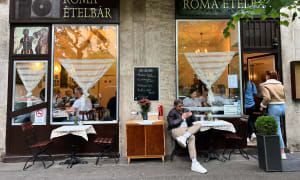
In 2020, following the retirement of the original owner, the legendary Cica, a young team decided to revive Róma Ételbár. Róma had been one of the last bastions of Budapest étkezdes: no-frills, affordable, lunch-only eateries once widespread in Hungary. Today, Róma’s dishes once again exclusively revolve around Hungarian classics and they are still pretty solid.

I can recommend the goulash soup, the liver dumpling soup, the goulash variations (pörkölt and paprikash), the layered cabbage, the rice pilaf (bácskai rizses hús), the schnitzels, and the the dessert specials such as the rice pudding (tejberízs) and the cottage cheese dumplings (túrógombóc). In line with étkezde standards, service is quick, the crowd diverse. For a post-meal drink with similar vibes, head to the nearby Bambi Eszpresszó.

#14 Tamás Kifőzdéje (Balla-Hús)

Opened in 1951, Balla-Hús is a butcher-shop-cum-eatery in downtown Budapest. Balla's business model has evolved over the decades: instead of raw meat, today it specializes in breakfast and lunch dishes to a shrinking number of local residents (Airbnb, I'm looking at you). I used to be a regular when I lived around the corner; in the morning, I would go for the scrambled eggs sprinkled with crisped-up sausages and red paprika.

During lunch, traditional meat-heavy dishes are laid out in the steam tables and usually include some kind of goulash, roasted and blood sausages, fried chicken liver, schnitzel, vegetable stews (főzelék), and pickled veggies. Let the Dionysian feast mural inspire your meal.

Hidden on a side street, Balla Hús is one of the few affordable eateries in the tourist-heavy downtown; accordingly, customers include everyone from bureaucrats from the nearby Mayor's Office to construction workers. Expect an especially generous portion if the owner himself serves you. Open Tuesday to Friday!

I visit all places incognito and pay for my own meals and drinks. I rely in large part on readers to support my work. I'm grateful if you make a one-time payment (PayPal, Venmo, Revolut) or subscribe to my weekly newsletter in which I write about Budapest and Vienna.