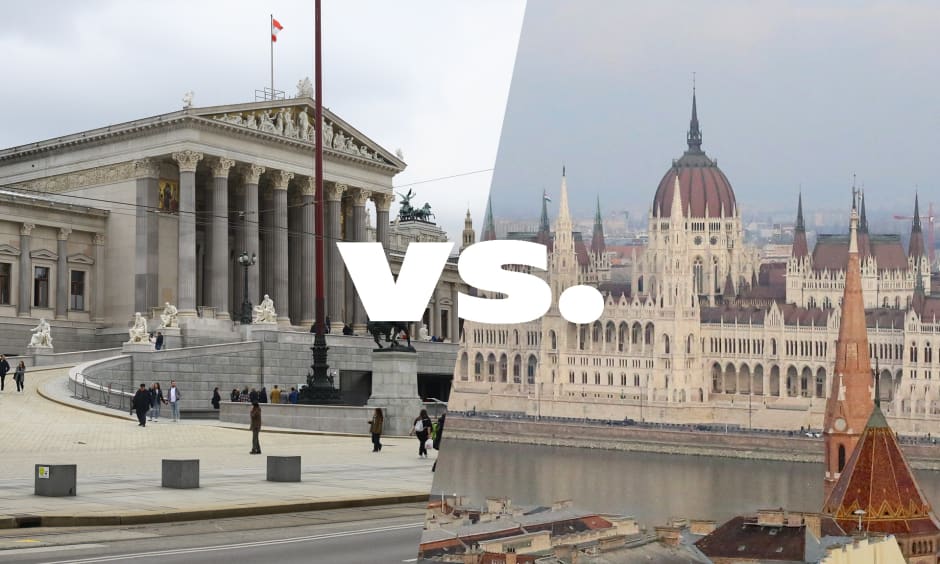
Given their proximity and shared history, Vienna and Budapest have a lot in common. There are also notable differences and it seemed like a good time to jot down some thoughts about how the two cities compare to one another. TLDR: They're both very nice places in general.
#1 - Vienna and Budapest are both among the largest capital cities in Europe with cultural, commercial, and dining offerings that few can rival. Nevertheless, they are no Paris or London, and the past century has seen events that actively undermined their inclusive and cosmopolitan nature starting with the 1918 collapse of Austria-Hungary: The ethnically tolerant, economically and intellectually thriving monarchy disintegrated into small, insular, and rather backward nations plagued by radical political ideologies, both left and right. Since the 1970s, Vienna has impressively revived itself. Budapest less so.
#2 - Vienna is significantly wealthier than Budapest (€53,000 vs. €33,000 nominal GDP per capita). Austria is one of the richest countries in Europe and its post-WWII economic performance is often described as miraculous for reasons that are rooted in favorable Cold War dynamics. This wealth difference has many implications, but it’s most obvious outside the center, when comparing Vienna’s road conditions and housing stock to those of Budapest, for example.
#3 - The legacy of the Habsburg family, which ruled Vienna (1278-1918), Budapest (1686-1918), and much of Central Europe for longer than any other dynasty, is unimaginably rich. In Vienna's center, almost every street, every building, every church, and every statue ties back to a Habsburg. The city has more than a dozen individual museums dedicated to the Habsburgs. There’s one for the Habsburg horse carriages, another for their furniture, yet another for their coronation regalia, and still others for their jewelry, art, natural sciences, books, musical instruments, and burial vault. The list goes on. Nothing like it exists elsewhere in Europe. Not even the Medici treasures compare, which, incidentally, fell into the Habsburg lap when they inherited the Grand Duchy of Tuscany in 1737.
#4 - Compared with other big cities in Europe, Vienna and Budapest are both safe, with excellent public transportation networks. Buses, trams, trolleys, and subways run frequently and arrive on time (try catching a bus in Rome). Crowding can be an issue in Vienna because of its recent population boom, worsened by a critical shortage of drivers. When it comes to being bicycle and pedestrian-friendly, Vienna is far ahead of Budapest.
#5 - The Danube flows through both cities, but Budapest is situated more favorably. Vienna’s city center is located away from the river, which splinters into smaller branches in the northeast. In Budapest, the Danube’s voluminous gray-blue cuts through the heart of town and is flanked by the dramatically soaring Buda hills that provide panoramic vistas of the flat expanse of Pest across the river. A beautiful Danube island (Margaret) is the cherry on top.
#6 - Vienna is separated from its Old Town (District 1). For many centuries, a wide stretch of protective open space stood between the historic city center and the rest of town. In the 19th century, this gap was filled by the Ringstraße and its famous buildings such as the City Hall and the Parliament, but a fifteen minute uphill hike or a few tram stops are still required to reach the residential neighborhoods that lie beyond the Ringstraße. This is why tourists often don't visit parts of Vienna where most people live. In Budapest, a few steps will get you from the Old Town to the lively District 7 and District 8.
#7 - Many tourists consider Budapest “cooler” than Vienna. I don't think this is entirely wrong and has to do with perceptions that Budapest is free-spirited and energetic whereas Vienna is more conservative and mellow. It doesn’t help that apart from churches, the whole of Vienna closes down on Sundays and an unnerving silence pervades the city.
The reasons are complex and go back as far as the Counter-Reformation and the Habsburg family, the most traditionalist dynasty in all of Europe. The Habsburgs regularly expelled Vienna’s most enterprising (Lutheran) residents and forced everyone else for centuries to adopt a strict Roman Catholic lifestyle that was rooted in religious rituals and piety. During the Holocaust, Vienna once more erased its most modern elements. For various reasons, none of these things applied to the same extent in Budapest. Recent Vienna census shows religious plurality and a rising share of the non-religious, but this long history of Catholic dominance can still be palpable, especially in the city center.
#8 - Vienna still has a highly stratified society, ranging from large working class neighborhoods on the city's outskirts to the upper crust of the city center. Unlike in Hungary, where the Communist regime persecuted the aristocracy and confiscated all of its assets, Austria has a thriving community of blue bloods who mostly live off their family lands. Uniformly dressed and with conspicuous mannerisms that are a source of both emulation and ridicule, they are easy to spot in District 1.
#9 - Average nominal rents are slightly higher in Vienna than in Budapest, but the whole housing picture is more complicated and interesting. Vienna has a famously good social housing system where rents are centrally controlled for about sixty percent of homes. Tens of thousands of new apartments are built every year, both rent controlled and open-market, which allows the city to keep up with its population growth and to keep rents under control. The result is that Vienna's rents compare favorably to other cities in Europe with similar wages.
Budapest, on the other hand, suffers from a critical housing shortage. It’s one of the most expensive rental cities in Europe relative to local wages. The problem is that most people don’t care about this, because home ownership is extremely high: due to post-Communist privatizations when people could cheaply buy the apartment in which they lived, only 20 percent of households rent their homes (in Vienna, rental is 80 percent). While high home ownership is a positive, the insufficient supply of apartments means it's expensive to buy or rent a place in Budapest for newcomers, for example university students from the Hungarian countryside.
#10 - Compared with other big cities in Europe, both Vienna and Budapest have an impressive lineup of museums. The collections often hark back to the Austro-Hungarian period (1867-1918), but not exclusively. Budapest's House of Music (2022) and Museum of Ethnography (2022) contain excellent permanent shows; in Vienna, the recently revamped City Museum and the early-modernist collection of the Leopold Museum (2001) are rightfully all the rage currently.
#11 - Special mention has to be made of the fine arts museums, among the very best in Europe. Vienna’s Kunsthistorisches is a legacy of the Habsburg family, while the old masters paintings in Budapest’s Szépművészeti came from Hungary’s high aristocracy and archbishops. (Please note that I occasionally give a 50-minute tour of the Szépművészeti where I talk about my favorite works and the history of the museum. I have two more tours this year, on September 13th and on December 6th.)
#12 - Before the Holocaust, Budapest was the second, Vienna the third biggest Jewish city in Europe (the biggest was Warsaw). In both cities, Jews were overrepresented within the fields of culture, arts, and sciences. In Vienna, the Holocaust almost completely ended Jewish life. 136,000 people escaped before the deportations began in 1941, while 65,000 were murdered in concentration camps. The complicity of the local population in the persecutions and the post-war denial of this responsibility remains a contentious and sensitive issue to this day.
In Budapest, despite horrific events in 1944-1945, most Jewish people survived and remained there and the city is currently home to continental Europe’s largest Ashkenazi community with an estimated 100,000 people who are completely secular. The presence of this Jewish community in Budapest has notable cultural and political implications. According to recent surveys, antisemitism in both Austria and Hungary is still among the highest in Europe.
#13 - In 1955, Austria regained its independence from the occupying Allied powers and joined the capitalist democracies of Western Europe. Over time, the stable political climate and the skyrocketing economy made Vienna a desirable destination for immigrants. Workers migrated from Turkey and Yugoslavia in the 1970s, from Poland, Romania, Hungary, Croatia since the early 2000s, and refugees from Syria, Afghanistan, Iraq, and Ukraine more recently. There’s also a big contingent of German students and even Jewish people re-appeared with the arrival of a few thousand ultra-orthodox Hasidim.
The result is that Vienna is becoming a mini "New York City of Europe." Nearly half of Viennese residents were born outside of Austria and the city’s population grew by almost half a million in the past two decades, reaching two million for the first time since the Habsburg period. The Viktor-Adler Market and the Brunnenmarkt are good places to appreciate this cultural diversity, which isn’t so apparent in the city center.
Still, Austria has not embraced itself as a multi-cultural haven for other nationalities. The rise of the Freedom Party (FPÖ) is closely tied to its anti-immigration rhetoric: the party first gained mainstream popularity after the 1989 fall of the Iron Curtain, when it played up the threat of Eastern European immigrants coming to Austria and taking the job of local people.
More recently, the FPÖ capitalized on the migration crisis from the Middle East with sharply xenophobic messages. The high unemployment rate among the newly arrived immigrants and the fact that they receive an increasing share of Austria's welfare benefits are causing widespread outrage, especially after some highly publicized cases. Surveys show that immigration is currently the most pressing problem for the majority of Austrians. The result: the FPÖ won the most seats in the Austrian central parliament during the recent elections of 2024.
#14 - The question of what it means to be Austrian has occupied Austria for much of the recent past, starting with the national revolutions of 1848. Are Austrian people German? Should Austria be part of Germany? The Habsburg Monarchy’s famously mixed populace gave no easy answers. Bismarck didn’t think Austria belonged to a unified Germany and fought a war in 1866 to exclude it.
After World War I, a truncated Austria desperately tried to unite with Germany and Hitler’s 1938 annexation of Austria fulfilled the wish of the majority. It wasn’t until the 1970s that Austrians started to embrace their independence as a small and successful nation that was different from Germany. (Hungary had its own complex ethnic questions before WWI, but it escaped this kind of identity crisis because there was no “big brother” across the border.)
#15 - After the 1989 fall of Communism, Budapest’s public administration was completely reorganized. With the new municipal laws, Budapest not only regained its municipal autonomy that had been rescinded, but its power was largely handed over to the individual districts. The result: each of Budapest’s 23 districts today has its own district-level city council and mayor who legislate and govern the district.
These local municipalities have outsize authority over everything from parks, to new developments, market halls, Airbnb laws, traffic decisions such as bike lanes and car-free zones. Effectively, Budapest has not 1 but 23 mayors, each with a distinct agenda and each answerable to hyper-local interests which don’t always overlap with those of Budapest as a whole. This explains the often sharp differences between neighboring districts. I don’t know of any other capital city in Europe with a similar setup (Vienna is far more centralized).
#16 - Budapest has been a far less popular destination for immigrants than Vienna for a combination of reasons. The 1948 Stalinist takeover and the ensuing Communist system (1948-1989), no matter how soft, translated to increasingly lower living standards compared to Vienna. More recently, Hungary's ruling far-right party (Fidesz) has been strongly anti-immigration. Apart from recent refugees from the Ukraine, the only sizable migrant group is the Chinese. With about 30,000 people, Budapest is home to one of the largest Chinese communities in Europe (and excellent Chinese restaurants). Chinese people came to Hungary in two waves: in the early 1990s and in the 2010s.
#17 - Vienna has maintained a robust coffeehouse culture. Both cities were known for their wonderful coffeehouses during Austria-Hungary, but the Communist nationalizations of 1949 decimated the coffeehouses of Budapest. A few were revived in recent years, but they cater mostly to tourists. Coffeehouses in Vienna, however, are still thriving among a large segment of the population, both young and old.
#18 - The foods of the twin cities overlap: they are a collection of best-of dishes from the Habsburg Monarchy, such as goulash, schnitzel, knödels, palatschinken, and strudels. It’s far easier to find excellent traditional restaurants in Vienna than in Budapest. Vienna is likely better represented because of its longer urban history, higher disposable incomes, and more conservative dining habits.
#19 - Naturally, both cities follow the latest global drinking and dining trends – for example, there’s an increasing number of restaurants specializing in shared-plates, fermentation techniques, and natural wines. These trends originated or were standardized in places like New York and Paris, and what a visitor from these cities finds in Vienna and Budapest might appear less developed or exaggerated.
#20 - Rather than simply mirroring global trends, a few places have shown exemplary creative imagination. Examples include Budapest’s ruin bars, which capitalized on the dilapidated housing stock of the old Jewish Quarter; new-wave bakeries that revived old recipes within a contemporary framework (Budapest, Vienna); and Vienna's rejuvenated sausage kiosks. In addition, both cities have an outstanding alternative bar scene. The success of these establishments shows that people appreciate a sense of place and a local angle.
#21 - Like other cities, historically Vienna and Budapest grew grapes for wine on their hillsides. Vienna still does. It’s one of the few metropolises still with massive vineyards within its city limits. This is thanks to the Christian Socialist mayor Karl Lueger, whose progressive building ban of 1905 protected the vineyards. (He’s the same Karl Lueger whose statue on Dr.-Karl-Lueger-Platz has been defaced by protestors because of his rabid antisemitism.) In the outdoor season, one can experience the local Viennese wines at the traditional wine taverns known as Heurigers.
#22 - Both cities boast some of the richest classical music calendars in Europe. Starting with the great classical trio of Haydn, Mozart, and Beethoven (to which sometimes Schubert is also added), Vienna has been a center of music since the end of the 18th century. Later came the Strausses, Brahms, Mahler, and the avant-garde of Schönberg. The Vienna Philharmonic still counts among the leading orchestras globally. In Budapest, Franz Liszt helped set in motion the musical life, which was carried forward by Béla Bartók and Zoltán Kodály and more recently Zoltán Kocsis and Iván Fischer. The Musikverein and the Konzerthaus (Vienna), and the Liszt Academy and Müpa (Budapest) are the most prestigious performance halls.
#23 - Gothic architecture exists in both cities, but Vienna’s Gothic buildings, such as the Saint Stephen’s Cathedral, are much grander in scale. There are two reasons for this. One, before the 15th century, Budapest wasn’t the main residence of Hungary’s royal family. Two, many Gothic-style buildings, including the Buda castle of King Sigismund of Luxembourg, were reduced to rubble during the Ottoman occupation (1541-1686).
#24 - Neither Vienna nor Budapest has much Renaissance art or architecture despite the extraordinary Renaissance-era remains of King Matthias Corvinus’s Buda castle (visible in the Budapest History Museum on the Castle Hill). The reason: the Habsburgs shifted their attention from Vienna to Prague in the 16th century. At the same time, Budapest was occupied by Ottoman Turkey, which left its own unique built environment, especially in the form of thermal baths.
#25 - Apart from Rome and Paris, few cities in Europe can rival Vienna’s Baroque. Astonishing Baroque palaces, churches, and sculptures sprang up in the first decades of the 18th century under Charles VI, embodying the victory of the Habsburg Counter-Reformation. The Baroque in Budapest is less developed because it coincided with the bloody liberation wars against Ottoman Turkey which left the city in ruins and de-populated.
#26 - While Chancellor Metternich’s police-state stifled investments in Vienna in the first half of the 19th century, Budapest came into its own in those years. Fueled by enlightened aristocrats such as Count István Széchenyi and Hungary's progressive Palatine, Habsburg Archduke Joseph, this flowering period of romantic nationalism climaxed with the construction of the Hungarian National Museum and the Chain Bridge.
#27 - The second half of the 19th century was a good one across Europe, but Vienna and Budapest were both extreme cases, enjoying increasing prosperity, skyrocketing populations, and a massive construction boom. Budapest’s population, for example, went from 300,000 in 1870 to more than a million in 1910.
The result is the eye-catching architecture that still defines both cities. The radiating avenues of Budapest and the Ringstraße of Vienna are textbook examples of the Revival style to which architects such as Ödön Lechner in Budapest and Otto Wagner and Adolf Loos in Vienna added their own brand of Art Nouveau and proto-modernism that are still international benchmarks.
#28 - The first decades of the 20th century marked the intellectual and artistic peak of both cities. Vienna contributed to the international avant-garde with such figures as Oskar Kokoschka, Egon Schiele, and Richard Gerstl. The Hungarians were especially successful in the emerging field of photography – László Moholy Nagy, André Kertész, and Robert Capa each spent their formative years in Budapest. One can survey some of these artworks at the Leopold Museum and the Belvedere (Vienna), as well as the Hungarian National Gallery and the Capa Center (Budapest), for example.
The list of famous writers, philosophers, and scientists from this period is long and includes Sigmund Freud, Ludwig Wittgenstein, and John von Neumann. Many were Jewish who later fled from the increasing antisemitism and the Holocaust and became part of the great generation known bitterly as “Hitler’s gift to America.”
#29 - Culturally minded foreign tourists sometimes feel underwhelmed by contemporary Vienna and Budapest – the period after 1950. Apart from Vienna's current-day social housing system and exemplary urban progress, neither of the cities is any longer at the forefront of artistic or intellectual innovations. The reason is simple: they are no longer among the biggest and most dynamic centers in the world. Those places have shifted to the United States and Asia. Still, they're wonderful places to visit and live in.
#30 - Finally, a piece of advice in case you consider traveling between the twin cities. Among people who regularly make the journey, it would be hard to overestimate the collective admiration for RegioJet, a Czech rail company that operates four daily services. Our enthusiasm is boundless for good reasons. A one-way ticket costs about €10; for a couple of extra euros, one can upgrade to “Relax” and luxuriate in an oversized leather seat in a quiet car that comes with a service staff and free coffee orders.
I like to order the “Czech” dumplings with a side of boiled beef (€4), followed by the apple cake that costs fifty euro cents. Is sushi on your mind? No problem. I’ve yet to try the €3.80 maki rolls, but my friend says they are not bad at all, considering that we are talking Japanese seafood served on a train, in Europe, by a landlocked country. I have no idea what to make of these price points but I surely am grateful. Two-and-half hours of sheer, Central European luxury. (Your other option is ÖBB, the Austrian railway, which is also nice, but more expensive and without such perks and idiosyncrasies.)
My content is free and independent. I rely in large part on readers to support my work. I'm grateful if you make a one-time payment (PayPal, Venmo, Revolut) or subscribe to my weekly newsletter in which I write about Budapest and Vienna.