
Note that I planned, wrote, and recorded several Budapest tours on VoiceMap. The app uses your location to play audio automatically at the right time and place – you can put your phone away and roam the city with me, so to say. My tours: City Center, Jewish Quarter, Andrássy Avenue.
The inner part of Budapest's District 8, the area behind the National Museum, is known as the Palace Quarter, because the grand winter palaces of the Hungarian aristocracy cradle the museum. There was a specific reason for this: Between 1866 and 1902, the upper chamber of the Hungarian Parliament, which was made up of the high nobility, assembled in the ceremonial hall of the museum. Three of the most impressive palazzos are directly behind the National Museum on Pollack Mihály tér – the former homes of the Festetics, the Esterházy, and the Károlyi families.
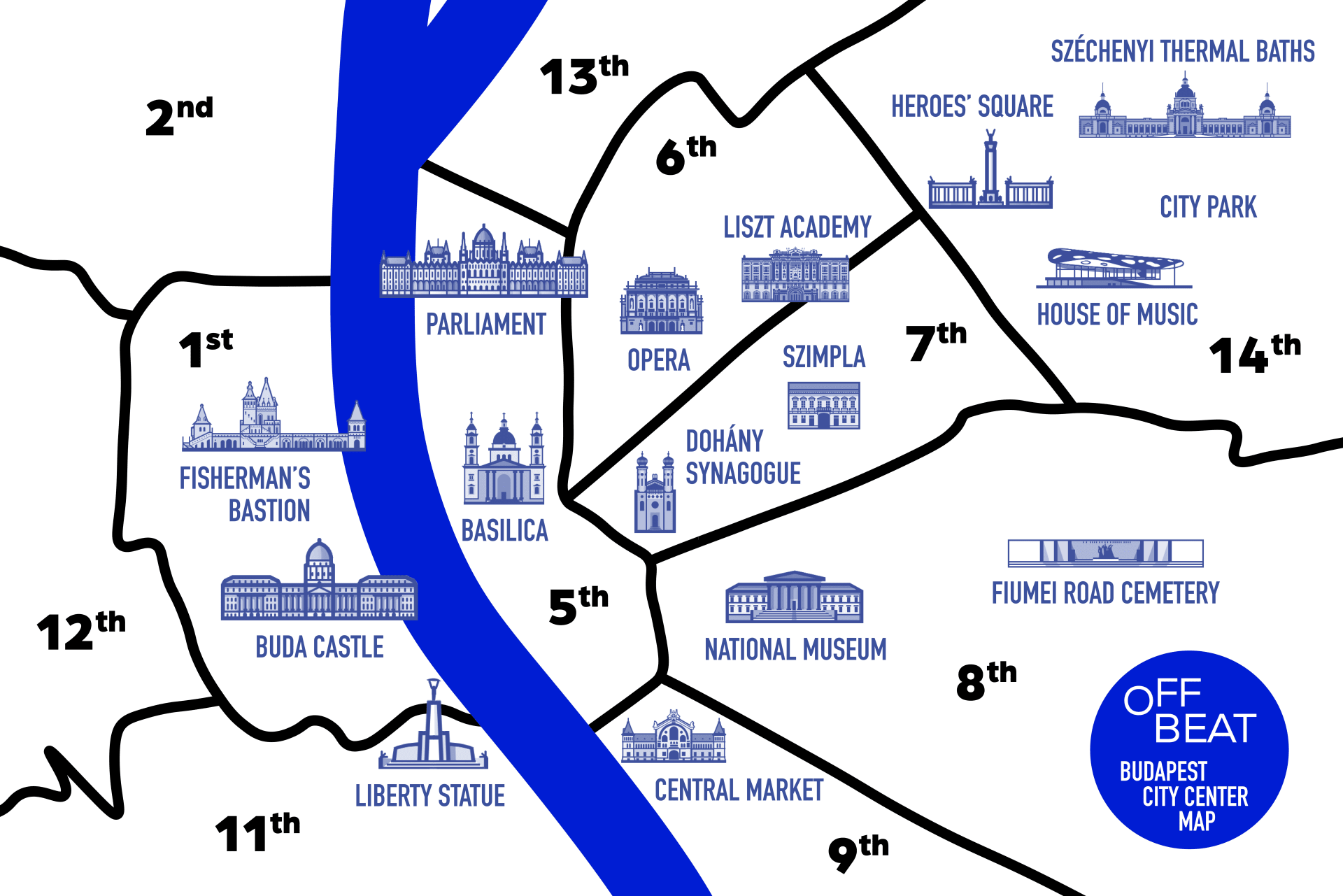
While the aristocracy is long gone – they fled the Communist regime before 1948 – the elegant neighborhood still exudes an air of upper class, pre-war Budapest in contrast to the more gritty and haphazard Jewish Quarter a few blocks away. Founded in 1802, the National Museum is the country's first museum with a stunning permanent collection. Designed by Mihály Pollack in 1837-1847, the museum-building counts among the great Neoclassical architecture of Europe, complete with a Pantheon-inspired hemispherical dome on the upper level. (Pollack was to Hungary what Karl Friedrich Schinkel was to Berlin and Leo von Klenze to Munich.)
The ground level explores the region's history through its various inhabitants from the Celts through the Romans, the Avars, and the Hungarian tribes, for example. There are fascinating archeological findings on display; I find myself returning to the Roman bronze busts, the elegant Avar archery equipment, and the jewelry worn by the Hungarian upper class in the 9th century CE. The halls upstairs deal specifically with the history of Hungary, from the Middle Ages to the 1989 fall of Communism.

Even if you don't feel like spending a whole day here, the astonishingly rich collection – with short and informative wall texts – is worth a glimpse (child-friendly, too). A special exhibition on the ground floor displays the Seuso Treasure, fourteen silver vessels from the late-Roman era that were unearthed in Hungary, as well as delightful pieces of Central European porcelain. A word to the wise: the museum's below-ground cafe serves more stuff at lower prices than the fancy-pants cafe beside the entrance.

The charming museum garden is sprinkled with statues ranging from a granite Corinthian column from the Forum Romanum that the city of Rome gifted to Hungary in 1929 to a bronze statue of the museum's notably handsome founder, Ferenc Széchényi. The museum garden hides a cute pastry shop, Geraldine, which serves excellent Esterházy tortes.

The Metropolitan Szabó Ervin Library, formerly the Baron Wenckheim Palace, offers a rare chance to glimpse the inside of these once aristocratic homes. Purchase a tourist pass for a small fee and proceed to the 4th floor, which has preserved some of the original furnishings. One will find students cramming for their exams in the former ballroom hung with a giant chandelier and decorated with Rococo motifs and in the mahogany-paneled cigar room.

The sixth floor of the library contains the amazing Budapest collection, with a constantly rotating exhibition. Many students take their study breaks at Fecske Presszó, a low-priced cafe outside the library. Tips for a quick lunch: Smashy is a very cool and very good smash burger takeout; Don Doko Don serves tasty Japanese rice bowl dishes.

The Palace Quarter doubles as a university district. A total of six universities have campuses near one another, including the German-language Andrássy University, the Pázmány Péter Catholic University's law faculty, departments of the Semmelweis and the Eötvös Loránd University, and Central Europe's only university for Jewish studies. This means that wallet-friendly bars, cafés, and tea houses abound.

I usually grab coffee at Kolibri or Lumen. It is worth checking back in the evening, when Lumen transforms into a lively bar with regular music concerts. Steps away are two excellent art galleries: TOBE specializes in contemporary photography, while Molnár Ani showcases paintings and installations.

Horánszky utca terminates in a cute Italian neighborhood restaurant, Al Dente. Next door to it hides Typo Showroom, a small vintage clothing store specializing in higher-end labels (more Budapest shopping ideas: this way). Craft beer fans can sample a wide array of local options at the sleek Mixát bar, while those in search of an immersion into everyday Budapest might want to continue toward Krúdy Söröző.

The outer part of District 8, beyond the Grand Boulevard, still suffers from a somewhat bad reputation but the wheels of gentrification keep turning and many old-time residents – including Romas and other ethnic minorities – are being replaced by newcomers. Vaj, a new-wave bakery on Rákóczi tér, embodies this new spirit. It is unfortunate that their pastries are so incredibly expensive that they are out of reach for most neighborhood locals.
Some of my favorite bars around here: the dim Hintaló Iszoda is teeming with cozy nooks and crannies; the similarly atmospheric Macska (upstairs!) caters to vegans and craft beer drinkers; while at Zsír (Fővárosi Kulipintyó) one can run into high-energy folk music concerts (schedule). All of them ideal for a date night. A ten-minute walk from the Rákóczi Market lies Műterem Kávézó, a specialty café whose owner deserves a hat-tip for serving moderately priced premium coffee in this part of the city, away from the well-trodden center.

Népszínház utca has long been a melting pot of immigrants, minorities, and the working class. The lively streets and small businesses – including a Persian and a Turkish grocery store, a Nigerian barber shop, an Afghan takeout – present a slice of Budapest's ethnic and cultural diversity that even many locals are unaware of.

The neglected condition of the buildings stands in contrast to the pristine facades of downtown. Off Népszínház hides the wonderful Öcsi, an old-school neighborhood eatery run by a husband and wife duo. Erzsi's daily vegetable stews (főzelék) and schnitzel variations are especially delicious. Lunch only, Monday to Thursday. Excellent post-meal specialty coffee can be had at Kastner, and traditional pastries at Jezsek Cukrászda where I like to order the ground walnut-filled svájci kifli.

Starting with Père-Lachaise in Paris, some cemeteries in Europe became more than just places of private burials and remembrance. From the 1820s, grand garden cemeteries accommodated large public ceremonies where crowds of mourners would show their support for the national heroes for whom grand funerary monuments were raised by public subscription.
In Budapest, the greatest funeral processions concluded at the Fiumei Road Cemetery, such as those of the politician Ferenc Deák (1876), the revolutionary leader Lajos Kossuth (1894), and the painter Mihály Munkácsy (1900). Here also rest the great Art Nouveau architect, Ödön Lechner, the Romantic writer Mór Jókai, members of the Gundel and the Gerbeaud families, behind the famous restaurant and pastry shop.

In the Communist period (1948-1989) the Party monopolized the cemetery but today once more Hungary’s greats are laid to rest here. Anyone is free to roam through this precious patch of green layered with impressive mausoleums and tombstones – some grand, others graceful, yet others extravagant. For example, the tomb of the film producer Andy Vajna, who died in 2019, is decorated with photos of his famous friends, Arnold Schwarzenegger and Sylvester Stallone!

In the back but accessed from outside lies the Salgótarjáni Street Jewish Cemetery which contains the funerary monuments of the Jewish upper class, including such well-known Hungarian industrialist families as the Weiss von Csepel, the Hatvany-Deutsch, and the Buday-Goldberger. One could round out a Józsefváros trip with a hearty meal at Rosenstein, an excellent traditional restaurant. The easiest way to return to the city is by taking one of many buses that connect Keleti railway station with downtown (#5, #7, #8, #110, #133).
My content is free and independent. I rely in large part on readers to support my work. I'm grateful if you make a one-time payment (PayPal, Venmo, Revolut) or subscribe to my weekly newsletter in which I write about Budapest and Vienna.