
Note that I planned, wrote, and recorded several Budapest tours on VoiceMap. The app uses your location to play audio automatically at the right time and place – you can put your phone away and roam the city with me, so to say. My tours: City Center, Jewish Quarter, Andrássy Avenue.
Know before you go
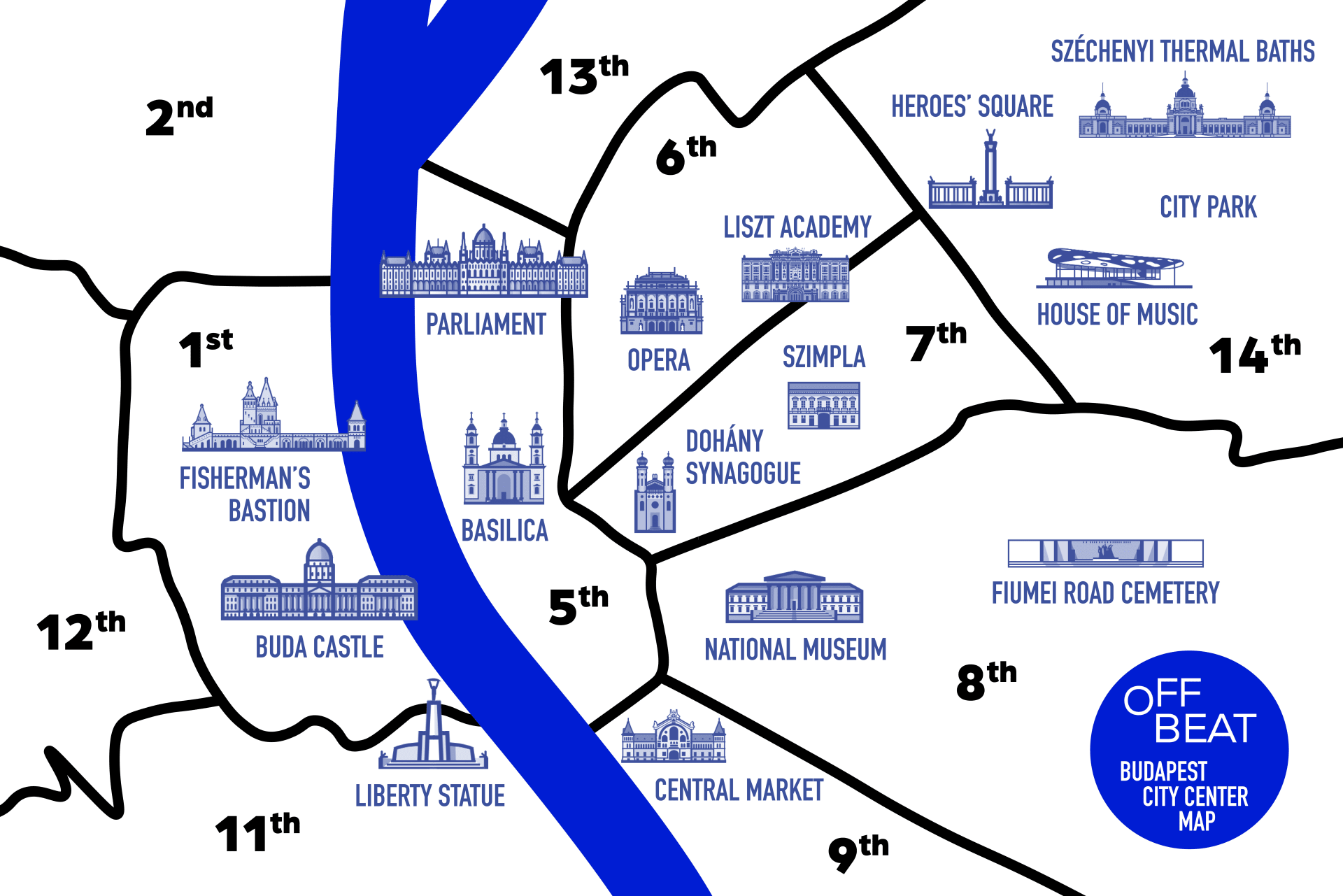
The medieval Old Town on Budapest's Castle Hill is a blend of old city charm and mass tourism. Life on the Castle Hill began in the 13th century, after the Tatars and Mongols decimated the flat Pest side and the survivors recognized the strategic benefit of the hilltop across the Danube River. The Castle Hill today bears marks of countless battles that took place here over the centuries, most recently a month-long, bloody siege between the Soviet-Romanian and German-Hungarian armies during WWII in 1945, which left tens of thousands dead, the area destroyed – hence all the modern buildings mixed in with the medieval and Baroque houses.
Only parts of the Castle Hill were restored during the Communist era (1948-1989) due to budget constraints; today, partially funded by the EU, many of the vanished buildings are springing back to life as perfect copies of what had been lost. In fact, the neighborhood is regaining some of its political weight as government ministries, including the Prime Minister's Office and the Ministry of Finance, are moving back here from the Pest side. I view the redevelopment of the Castle Hill as a positive, but I wish that contemporary architecture also got a chance to leave its mark.

The Castle Hill consists of two parts, split by Dísz tér in the middle: the former royal castle houses the National Gallery, the Budapest History Museum, and the Széchényi Library, whereas Úri, Országház, Fortuna, and Táncsics Mihály streets comprise residential neighborhoods. The residents of the Castle Hill are mainly senior citizens as younger people tend to flock to less-touristed parts of town with a more active nightlife – strict landmark regulations make it difficult for new places to open; for example, there's just a single grocery store up here. As night falls and tourists retire, the Castle Hill becomes eerily empty (which makes it a good time to visit it).

Step-by-step
Try to stock up on caffeine and arrive with a full stomach because the Castle Hill is undersupplied with cafés and restaurants. The panoramic way to reach the area from Pest is via the Chain Bridge, recently pedestrianized, followed by an uphill climb up Király lépcső, the trail setting off on the right-hand side of the tunnel. Take a sharp left at the first chance for a view of Pest from the terrace atop the tunnel. An even better option: Castle Hill funicular.
The second half of the 19th century brought revolutionary advancements in urban transportation and Budapest was among the first to introduce new forms of transport starting with the Castle Hill funicular (1870), followed by the cog-wheel railway (1874), and the Millennium underground (1896), all of which are still operational today. This steeply ascending funicular, the second oldest of its kind in the world, was built to provide easy and affordable connection between the Chain Bridge and the ministries on the hilltop.

Destroyed in WWII, the funicular was rebuilt in the 1980s with a pair of old-school cars that evoke the originals, although no longer steam-powered. They each have a name: Margit and Gellért. Have your camera ready because the scenic ride takes only about two minutes. Note that the tickets are round-trip and the experience might involve some waiting in line during peak hours.
The best photo ops from the royal castle are from the narrow cantilevered structures hanging over the city walls, beyond the equestrian statue of Prince Eugene of Savoy, the great general who routed Ottoman Turkey from this part of Europe. After WWII bombs damaged the castle, the ensuing Communist regime knocked down precious and salvageable Baroque and neo-Baroque elements out of a misguided sense of anti-royalism. Starting in the 1960s, the castle was turned into a cultural complex, housing the National Gallery, the Széchényi Library, and the Budapest History Museum.
The National Gallery occupies the river-facing side. The museum's expansive collection features wonderful paintings and sculptures by the country's greats, such as Mihály Munkácsy (think Hans Makart), the pointillist József Rippl-Rónai, the Henri Rousseau-like Tivadar Csontváry Kosztka, and the pioneering minimalist Vera Molnár (here, my favorites). Note that there's a cafe on the monumental first-floor terrace of the museum and that anyone with an admission ticket can also access the dome up top for 360-degree Budapest views.

It took me a little bit to get used to the emphatically 1970s interior of the castle's grand halls, but I have fully come around. This is what I meant by earlier by each generation leaving an architectural legacy. Some people within the architecture community worry that this spectacular socialist modern interior will become a victim of the current re-historicization efforts.

In the back of the castle hides the Budapest History Museum, containing the Gothic and Renaissance remains of King Matthias Corvinus's palace which were unearthed after the 1945 bombing of the Castle Hill. Upstairs, there's a somewhat dated but interesting exhibition on the history of Budapest. Also here: the completely over-the-top Saint Stephen's Hall, a 19th-century neo-Romanesque chamber recently renovated, its surfaces still glinting and shining from all the polished splendor.

What Jean-Baptiste Carpeaux was to Paris and Viktor Tilgner to Vienna, Alajos Stróbl (1856-1926) was to Budapest: the country’s greatest realist sculptor, known for his energetic and expressive renditions of the famous and the historic. Stróbl's King Matthias Fountain, carved in 1904, is among my favorite sculptures in Budapest. It shows Hungary’s dashing Renaissance king presiding over a hunting scene, bow and arrow in hand, his antlered kill lying lifeless before his feet.

Matthias’s two aides exude supreme confidence while three loyal vizslas are ready for more action. Szép Ilonka, the village girl with the baby deer doubles as Diana, goddess of hunting. I love the deadpan smirk of the figure of Galelotto Marzio at all of this machismo; he was an Italian humanist thinker who joined Matthias’s court in Buda (lower left corner).

Toward Dísz tér, one will encounter some of the recently resurrected buildings (Royal Guard and Riding Hall) and the offices of the Hungarian President and Prime Minister on Szent György tér. The scenic Tóth Árpád sétány overlooks the softly rolling Buda hills where much of the city's middle and upper-middle classes reside. It is here that one might catch a glimpse of long-time Castle Hill residents. Turn right at Szentháromság utca and you are just steps from the Matthias Church.

You will pass the legendary Ruszwurm pastry shop that counted Queen Sisi among its clients. Operating continuously since 1827, Ruszwurm has retained its original Biedermeier furnishings – a softer version of French Neoclassicism. The specialty of the house is the custardy krémes and the creamy hot chocolate. Try to go in the morning (they open at 10 a.m.) for the shortest lines and widest selections. 2025 August update: due to a legal dispute between the local municipality and the owners, Ruszwurm is currently non-operational.
Little has remained of the modest medieval church where people such as Matthias Corvinus and Habsburg Franz Joseph were crowned King of Hungary since architect Frigyes Schulek transformed the Matthias Church into the exuberant Gothic Revival building we see today (similar to how Viollet-le-Duc "updated" the medieval Notre-Dame in Paris in the late 19th century). The dim inside is coated in an immensely ambitious 19th-century fresco cycle honoring the life of the Virgin and the saints of Hungary.

Hungary's medieval king, Béla III, and his wife, Agnes of Antioch, are buried inside. Franz Joseph footed the bill of their reburial; in exchange, the Habsburg king was awarded a marble plaque showing his family tree snaking all the way back to Béla III... One can peruse its contents next to the royal couple's tomb. Note that the Matthias Church charges a small admission fee.

Outside the church, that stern and confident gentleman cast in bronze is the canonized Stephen (975-1038), the country’s first king who laid the foundations of Christian Hungary. The base of the monument shows scenes from his life, including his coronation, his legislative work, his financing of new church buildings, and his suppression of Vienna.

In front of the church on Szentháromság tér rises a Baroque plague column (1713), which was a Habsburg specialty: as a token of gratitude following a plague, the surviving residents erected such oddly shaped monuments adorned with flying angels and the patron saints of plague victims such as Saint Roche, Saint Sebastian, and Carlo Borromeo. While impressive, this one doesn't come close to the prototype of such objects, located along Vienna's Graben.


Beside the Matthias Church stands the fairy-tale-like Fisherman’s Bastion which is a similar 19th-century reimagination of the medieval past by architect Frigyes Schulek. The soaring white towers sync up with the church and offer stunning Budapest vistas. There's a small admission to enter the upper deck from which the views are especially impressive.

Next door is the Hilton, Budapest's first five-star hotel in the Communist period. The building flaunts a mixed facade: the original Baroque walls were home to a Jesuit high school before WWII; glass and precast concrete panels face the Danube side. I wouldn't normally recommend a Starbucks, but this one is among the few coffee options up here.

Koller Gallery on Táncsics Mihály utca is a pretense-free art gallery with incredible views and wonderful 20th-century Hungarian art. The top floor contains the memorial room of the Hungarian sculptor, Amerigo Tot, whose studio this once was and whom you might recognize from his cameo appearance in The Godfather Part II. Next door, the lavish Baroque palace at #7 belonged to the aristocracy before the Communist nationalizations (it was built for the Erdődy and later purchased by the Hatvany family). Today, the Institute for Music occupies the halls with a permanent exhibition about rare musical instruments made in Hungary between the 18th and 20th centuries.

This street is also where the medieval Jewish Quarter once was. A small exhibition at #26 shows the remains of a Sephardic prayer room and headstones found in a nearby Jewish cemetery. Across the street, under the building at #23, stood the much larger Gothic-style synagogue of the Ashkenazi Jews. The synagogue was destroyed during the 1686 liberation war against the Ottoman army and the remains are yet to be excavated. (In this article, I wrote in detail about Budapest's Jewish past and present.)

Táncsics Mihály utca terminates at the northern gate of the Castle Hill, but don't leave before stopping by the lonely tower of the Saint Mary Magdalene Church a block away. One of the first Gothic buildings in Budapest, Béla IV of Hungary commissioned it in the 13th century in order to serve the city's Hungarian community (the German residents attended the nearby Matthias Church).
The white Neoclassical entrance portal was added for the 1792 coronation of Habsburg Francis as King of Hungary. After WWII bombings damaged the church, the hardline and anti-religion Communist regime of the early 1950s decided to knock it down instead of restoration. Only the late-Gothic, four-story tower has remained, soaring above the city and offering stunning views (with a small admission fee to go up).

At the end of the 18th-century the so-called Copf Style embodied the transition from the Baroque to Neoclassicism, reflecting the emerging ideas of the enlightenment and its cool rationality. Facades became flatter, less tectonic, and featured simpler entrance gates and rectangular window surrounds. Reliefs, medallions, and braided strings replaced the more expressive Baroque sculptures and statues ("copf" translates to braided hair in Hungarian and German).

József Grigely, a teacher of humanities and a high school principal, lived in the building at 7 Bécsi kapu tér. He flaunted his classical learning by commissioning portrait medallions of Virgil, Cicero, Socrates, Livius, Quintilianus, and Seneca, as well as reliefs showing the allegories of arts and sciences. The house later went to Lajos Hatvany, scion of a wealthy industrialist family and himself a literary critic who socialized here with writers and poets. The names of his famous guests, including Thomas Mann, Sándor Márai, and Béla Bartók, are carved into the pavement in front of the house.
Finally, some nearby dining options. 101 Bistro is a trendy pan-Asian restaurant on Széll Kálmán tér. A bit further, Bambi Eszpresszó is a low-priced, old school cafe dating back to the 1960s. Also within walking distance: Déryne, a pricey and fashionable bistro, and Dang Muoi, an unpretentious Vietnamese restaurant.
My content is free and independent. I rely in large part on readers to support my work. I'm grateful if you make a one-time payment (PayPal, Venmo, Revolut) or subscribe to my weekly newsletter in which I write about Budapest and Vienna.