A collection of objects from the celebrated architect-designer’s Cape Cod summer house were purchased by the Hungarian Museum of Architecture.

If I asked you to name a globally famous Hungarian person, chances are that you wouldn’t be able to come up with anyone, which I can understand. If you were, it might be somebody who grew up in Hungary and emigrated after the 1918 collapse of the Dual Monarchy. John von Neumann, for example, the mathematical genius, or László Moholy-Nagy or Robert Capa.
The thriving scientific and artistic ferment that was Budapest under Austria-Hungary gave way to an increasingly insular atmosphere in the 1920s and 1930s. The subsequent one-party Communist dictatorship wasn’t the kind of place that cultivated the flourishing of individual talent even if it’s possible to point to exceptions, such as Ernő Rubik, the inventor of the Rubik’s cube.
Marcel Breuer was born in 1902 in an assimilated middle-class Jewish family in Pécs, in southwestern Hungary. After high school, the artistically minded Breuer got a scholarship to study painting in Vienna, but after a few weeks he dropped out of the Academy of Fine Arts, instead following his Pécs friends at the Bauhaus, the free-spirited avantgarde art school in Germany. Breuer wanted to study glass painting, but his mother suggested that he pick a more practical field, so he joined the school’s carpentry workshop.
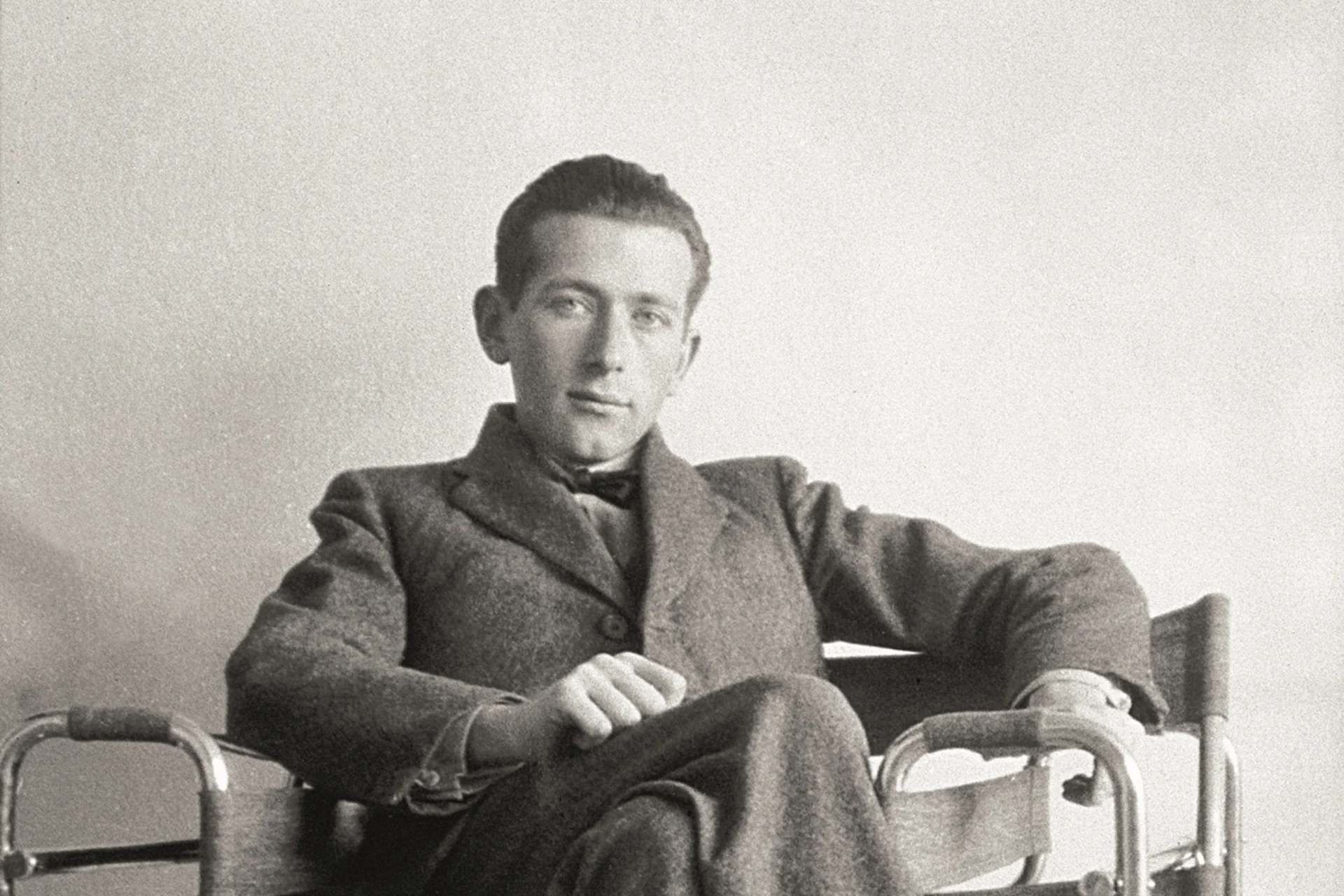
So began the career of one of the most celebrated furniture designers and architects in the world! Gifted and ambitious, Breuer quickly established himself as a star student at the Bauhaus and was later appointed the youngest teacher on staff, in charge of the furniture workshop. In 1925, Breuer became the first person in the world to design furniture using bent steel. Inspired by his bicycle’s frame, these light, tubular steel chairs – such as the Wassily – were revolutionary for the time when overstuffed armchairs were still a standard.
All his life, Breuer was interested in the juxtaposition of different textures and materials. With his most famous chair, the Cesca, which is named after his daughter Francesca, he contrasted the wood and cane seat with the streamlined, cantilevered steel frame.

Breuer’s focus gradually shifted to architecture; in the 1930s he designed buildings in Germany and Switzerland and returned to Hungary to work as an architect. But he faced administrative and political headwinds – ironically, he didn’t have a degree in architecture, because the Bauhaus didn’t officially teach architecture when he was there. He was overjoyed when Walter Gropius, the former Bauhaus director, by then the department chair of architecture at Harvard, offered him a faculty position. At age 35, in 1937, Breuer moved to Massachusetts to spread the gospel of modern architecture to a group of students that went on to shape American architecture.

Breuer later set up a successful practice in New York and Paris and designed many well-known buildings, including the UNESCO headquarters in Paris and the old Whitney Museum in New York (the new headquarters of Sotheby’s). Despite his global fame, Breuer remained connected to Hungary through family and former colleagues. He was known to support Hungarians who were new to America. He spoke English with a thick Hungarian accent and his mistranslations were a running joke in his office. There were plans in the 1970s for him to design a building on Budapest’s Castle Hill but he was in ill-health by then and couldn’t travel.

The reason I know all this is that in 2022, I was in the US researching Breuer’s life. I interviewed many smart and generous people who helped bring alive Breuer’s memory. I got to visit Breuer’s vacation house deep in the woods of Cape Cod, where he spent the summers with his family until his 1981 death. Some of his artist friends, many from Hungary, also had houses there. I found the Breuer house in poor condition but also untouched by time: piled with Breuer’s own furniture, paintings, books, photos, and personal belongings (for example, the Hungarian-German dictionary of the young Lajkó – his first name was Marcell Lajos and most people called him Lajkó even in America).

I told Peter McMahon, whose non-profit was in the process of buying the house from Breuer’s son, Tamás Breuer, that in an ideal world, some of this stuff would be exhibited in a museum in Hungary. Peter gave me an understanding shrug of solidarity. In fact, when I returned home, I contacted the people at the Hungarian Museum of Architecture in Budapest, suggesting that they get in touch with Peter and try to purchase and “bring home” a piece of this incredible cultural legacy.

After two years, and countless hours of phone conversations, draft documents, and frustrating dead ends, my initial idea came to fruition! Last Monday, the museum presented to the public the objects that were purchased from Breuer’s summer house: five pieces of furniture, including a Wassily and a Cesca; the rights for one hundred (!) never-before-seen photographs of Breuer and his Cape Cod circle taken by Tamás, who is a photographer; twenty books dedicated to Breuer by famous people; and two paper maquettes. It was a big event – the keynote speech given by the State Secretary of Architecture, Regő Lánszki.

During the ceremony, I was the first person to be thanked by the museum’s director, Kornél Almássy, but I know that this transaction would not have materialized without the tireless work, gentle persistence, and diplomatic skills of Ágnes Anna Sebestyén, the museum’s curator. She gave a fantastic tour of the objects to a sold-out audience on both Monday and Tuesday (they will now go into storage until the museum’s upcoming exhibition in the spring).

These artifacts would not be in Hungary without the loyal support of the architect Peter McMahon. After the New York Times featured a big story in 2023 about the renovation of the Breuer house and Peter’s fundraising effort, his foundation, the Cape Cod Modern House Trust, was on track to reach its financial goal. But Peter didn’t turn us away. I think because he understood Breuer’s connections to his homeland and what having these objects at the Hungarian Museum of Architecture would mean to us.
What do these objects mean to us? There’s an element of national pride, of course, but I think this deftly selected collection manages to achieve a lot. I have been at turns educated, inspired, and entertained. The photos are fun! There’s even an aesthetic experience: that Isokon Long Chair, perhaps the most treasured piece of the bunch, looks absolutely stunning.

Our initial agreement with Peter included a month-long residency for a Hungarian architect or researcher in the Breuer house. Unfortunately, we had to cut our loftiest ambitions for financial reasons. But the summer house contains many more treasures and I am hopeful that the collaboration with Peter will continue and that Hungary will one day become a center of Marcel Breuer’s legacy.
Under Peter’s helm, the renovation of the Breuer house was recently completed and the place looks beautiful. It functions in part as an artist’s residence, in part as a rental property. I’m told that paying guests are heavy on deep-pocketed Massachusetts professors who appreciate this kind of indulgence.