Brainy college students, fashionable Millennials, and middle-class locals make this a lively area filled with cafes, bars, and art galleries.

Note that I planned, wrote, and recorded several Budapest tours on VoiceMap. The app uses your location to play audio automatically at the right time and place – you can put your phone away and roam the city with me, so to say. My tours: City Center, Jewish Quarter, Andrássy Avenue.
When it comes to food, drinks, culture, and nightlife, the Buda side of Budapest can't hold a candle to Pest. In fact, until recently, it was difficult to find a single Buda neighborhood that even remotely resembled the lively pockets across the Danube. It is also true that many locals don't mind this, preferring to keep Buda a peaceful residential area.
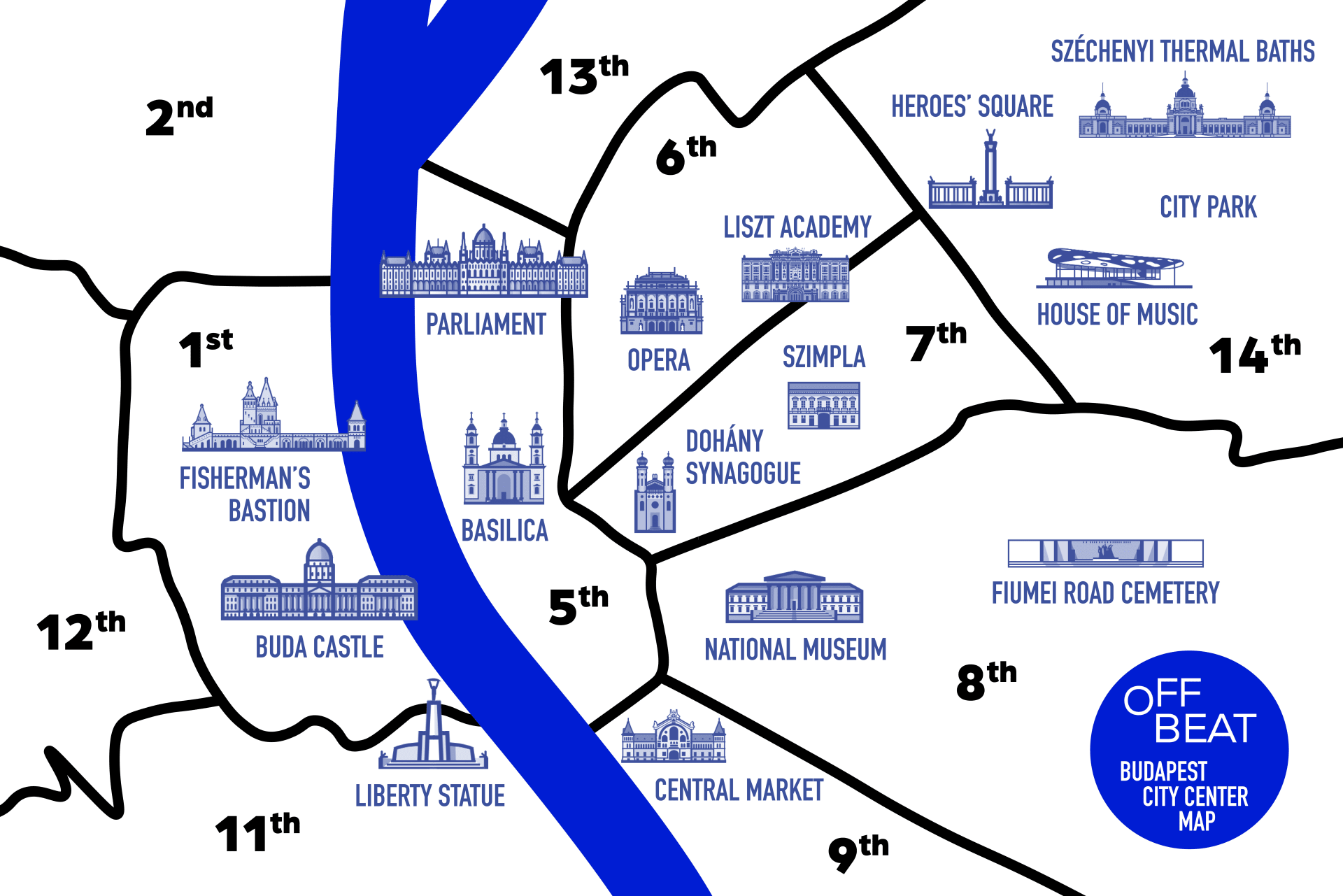
But over the last decade or so, galleries, cafés, restaurants, and bars have sprung up on and around Bartók Béla út, a boulevard with wide sidewalks in District 11. This transformation was part of a systematic urban renewal that selectively drew commercial and cultural establishments to the neighborhood with below-market rents and other district-level benefits.

The scenic way to reach Bartók Béla Boulevard from Pest is through Liberty Bridge. Dating back to 1896, the Liberty Bridge is the third oldest in Budapest after the Chain Bridge and the Margaret Bridge; it was initially named after Hungary’s longtime King, Franz Joseph (1830-1916). During his 68-year reign, Franz Joseph went from being a hated military-obsessed autocrat who banned the constitution and executed the Hungarian revolutionary heroes of 1848, to a widely respected arch-grandfather of the nation who oversaw the greatest transformation of the Habsburg Monarchy.
Hungary enjoyed impressive economic growth during his reign, especially after the 1867 creation of Austria-Hungary. In 1946, the bridge was renamed to Liberty Bridge by the Communist regime, but the small kiosk on the left of the bridge, Pest side, still shows Franz Joseph’s name. Also note the Art Nouveau-ish decorative details of the bridge itself given that its construction overlapped with the peak of the Art Nouveau style.

Those with extra energy could hike up to the Liberty Statue perched atop Gellért Hill – few cities have panoramic hiking trails right within their city center! The trail sets off opposite the Gellért Hotel, by the Cave Church, which was built into the hillside in the 1930s together with the Novecento style monastery beside it, facing the Danube. They are managed by the Order of Saint Paul the First Hermit, the one and only monastic order that originates in Hungary. (During the Communist period, between 1950 and 1989, the order was banned, church was walled off, and the monastery used as a college dorm.)

The uphill climb on Gellért Hill takes about twenty minutes and features several lookout points, terminating in the sculpture group up top presided over by the allegorical figure of liberty. It was sculpted in 1947 by Zsigmond Kisfaludi Strobl on the order of Marshal Voroshilov, head of the invading Soviet army that liberated Budapest from the Nazis. The Soviet propagandastic elements and the inscription were removed after the fall of Communism (1989), but the figure of the woman has remained and become a Budapest symbol.

Unfortunately, it is currently not possible to soak yourself inside Gellért Bath's Art Nouveau halls, because Gellért is undergoing a much-needed gut renovation and will remain closed until early 2029. Further up on Bartók Béla, the tiny Pékműhely serves delicious morning pastries; I especially recommend their kakaós csiga (chocolate-filled roll) and the túrós táska variations (pastry filled with sweet-tart cottage cheese).

Kelet, a specialty coffee shop, was a pioneer of the neighborhood's nascent rebirth. Books line the walls of this snug space, which fills to capacity at all times. Recently, the owners opened another inviting and usually less crowded cafe a few doors up the street: Művház Kávézó.

I usually stop by Godot Gallery and Faur Zsófi Gallery to scan their exhibitions. Further up the street is another chic cafe and breakfast restaurant, Caphe by Hai Nam, run by a Vietnamese-Hungarian family. I like to descend toward the Danube's bank where stretches the imposing campus of the Budapest University of Technology, one of Hungary's seminal academic institutions with more than 20,000 students.

I enjoy roaming the university's leafy campus peppered with bronze busts of notable alumni and impressive architecture. The central "K" building was designed in 1909 by Alajos Hauszmann, the university's own professor and there's a fairy-tale looking Gothic Revival library and reading room ("Kö" building).

For an unusual type of architecture that one will not encounter in Western Europe, head to the “R” building of the university (1951-1955). Socialist Realism was the name of “Communist architecture” in the Eastern Bloc. It originated in the Soviet Union in 1932, when Stalin decided that he wanted a powerful propagandist style that was easily understood by the people and conveyed optimism about Communism. In architecture, Socialist Realism combined simplified Greek elements on a monumental scale with bas reliefs showing happy worker-heroes building the utopian State.

Sure enough, classical elements do mix with propaganda on the building's facade facing the Danube: a projecting axis; triangular pediment with a Roman thermal window; string courses with meander motifs; bas reliefs of the self-assured proletariat (especially on the back side, facing the garden). Gyula Rimanóczy was a good architect and he managed to abstract these decorative details just enough to avoid looking kitsch and embarrassing himself. Indeed, the vestibule is very grand and gorgeous and can be visited by anyone. Bonus: delicious toasted sandwiches are served at the cafe upstairs. Flanked by Greek columns, of course.

Across the campus, back toward Bartók Béla Boulevard, hides Fiók, a wonderful store specializing in designer stationery, luxe pencils for example (I'm a repeat customer because I lose or misplace about five pencils a week). The campus canteen, Stoczek, serves low-priced lunch surrounded by students and academic staff inside a socialist modern building. On Bartók, Moto is a chic Naples-style pizza shop, Buda Smash an excellent smash burger takeout.

Is it time for a drink? The good news: you have many options. Gdansk Bookstore Café attracts the city's Polish expat community with bohemian-intellectual vibes. Craft beer fans should settle in to KEG for hop-forward IPAs made by local microbreweries. Wine lovers: head to Palack. Many students from the university go to the cheap and somewhat grungy bars off Bartók Béla where retired neighborhood regulars and alcoholics also congregate. I recommend Libella and Borpatika, the latter also known for its delicious homemade pogácsa.
A38, docked on the Danube near the university, is a repurposed Ukrainian stone-carrier ship and one of Budapest's main concert halls with daily live shows – you might find something of interest.
My content is free and independent. I rely in large part on readers to support my work. I'm grateful if you make a one-time payment (PayPal, Venmo, Revolut) or subscribe to my weekly newsletter in which I write about Budapest and Vienna.