Budapest's Jewish Quarter has become the city's party district but it is worth peeking beneath the surface of this culturally rich neighborhood.

Note that I planned, wrote, and recorded several Budapest tours on VoiceMap. The app uses your location to play audio automatically at the right time and place – you can put your phone away and roam the city with me, so to say. My tours: City Center, Jewish Quarter, Andrássy Avenue.
A little history
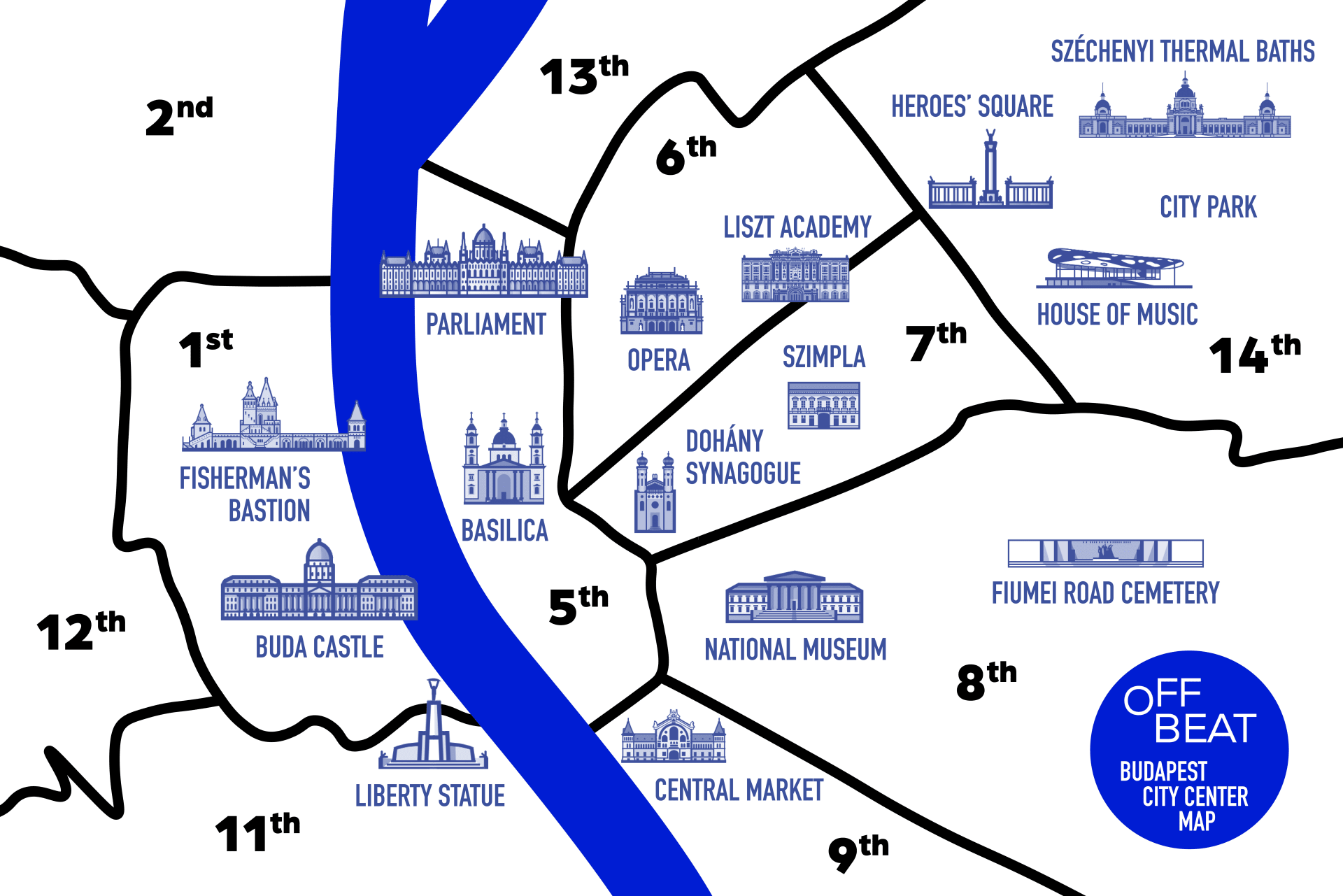
Budapest's Jewish Quarter is the inner part of District 7 – the area enclosed by Király utca, Erzsébet körút, Dohány utca, and Károly körút. It was here that Jewish people started to settle down in the late 18th century. This wasn't Budapest's first Jewish Quarter, but the medieval Jewish Quarter of the Buda side, across the Danube, was decimated during the 1686 liberation war against Ottoman Turkey.
By 1800, the Pest side of Buda-Pest became the commercial center of Hungary and the city's rapid urbanization and economic development presented plenty of opportunities for Jewish people, drawing them in increasing numbers. Previously, Jewish people weren't allowed to settle in Buda-Pest, so the biggest Jewish community emerged in Óbuda, today part of northern Budapest, on the dominions of the enlightened Count Zichy family. The Zichys actively welcomed Jewish settlers when they saw how much profit they generated on their estates; in return, they allowed them to build houses, schools, and synagogues.
The period between 1867 and World War I is considered to be the golden era for Jewish people in Hungary, when a unique alliance was formed between the political elites (notably Ferenc Deák, Gyula Andrássy, and József Eötvös) and the Jewish community. Hungary didn't have much of a middle class at the time and the Hungarian aristocracy relied in large part on Jews to transform this feudal country into a modern industrial and urbanized society; in exchange, unlike in neighboring Vienna, they crushed all political anti-Semitism.
By 1867, around the same time as in Western Europe and sooner than elsewhere in the region, Jewish people in Hungary gained full civil rights. As a result, the Jewish population continued to rise and by 1910, more than 23 percent of Budapest’s population was Jewish, over 200,000 people, making Budapest the second biggest Jewish city in Europe after Warsaw. Jews became the backbone of Budapest’s middle-class – around 60 percent of merchants, doctors, and lawyers were Jewish in 1910, contributing significantly to the city's progress.
The Jewish Quarter was a dense and lively neighborhood, teeming with retail stores, small artisans, kosher restaurants, and interconnected courtyards. The courtyards made life easier for observant Jews, creating a sort of public domain that allowed them to carry things and do some basic errands on Shabbat (they fell within the eruv).
Since most Jewish people truly felt accepted and at home in Hungary, their assimilation was extremely rapid. They didn't just speak and feel Hungarian, many of them even Hungarianized their last names which is why it's usually impossible to identify a Jewish person in Hungary based on his or her last name alone. This level of assimilation didn't exist anywhere else in Central and Eastern Europe.
There was a sharp divide between progressive Jews, most of whom lived in Budapest and other big cities, and orthodox Jews, who were mainly in the Hungarian countryside. The progressives, also known as Neologs, believed in the evolution of Judaism and took steps to assimilate into the local society: spoke Hungarian rather than Yiddish or German; gave up religious clothing; adjusted the Jewish liturgy to resemble a Christian worship. They also fought alongside Hungarian soldiers in the 1848 War of Independence against the Habsburg army.
Orthodox Jews resented the assimilation efforts of the Neologs. They thought these concessions were pointless and that they compromised their religious beliefs and their whole lifestyles. As a result, after the 1869 Hungarian Jewish Congress, the two factions officially split (there was a third, smaller group called "Status Quo Ante" that wanted to keep things as they had been). It is because of this schism that Budapest's Jewish Quarter has three stunning synagogues near one another – Dohány, Rumbach, and Kazinczy. One for each faction.

The mutually beneficial relationship between the Hungarian political elite and Jewish people, most of whom were highly assimilated patriotic Hungarians, began to deteriorate after WWI and culminated in the tragic events of the Holocaust. In March, 1944, the German army invaded Hungary; Hungary was a German ally, but Nazi Germany worried that Hungary might switch sides as they were losing the war. Initially, the Jewish people of Budapest were detained in so-called starred houses that were scattered across Budapest.
In the winter of 1944, German and Hungarian Nazis relocated 70,000 Jewish people into the Jewish Quarter, which was turned into a walled-off ghetto. Thousands died there of famine and starvation. Crucially, though, in January 1945, the Soviet army liberated the ghetto and saved its residents from mass deportations to Auschwitz.
This is why, despite horrific persecutions and murder, Budapest's Jewish community escaped the Holocaust and why Budapest remains today the largest Ashkenazi city in continental Europe with about 100,000 people. (Countryside Hungary was a different story: 437,000 Jewish people were deported to Auschwitz and most of them killed there; a result is that very few Jewish people live in Hungary today outside Budapest.)

The Jewish Quarter today
As with other inner city neighborhoods, the Jewish Quarter declined in the 1950s as residents moved out and to the suburbs, or fled Communist Hungary altogether. It was in the early 2000s that the neglected streets and dilapidated buildings of the old Jewish Quarter gave rise to a revitalized Hungarian culture prompted by the appearance of ruin bars – quirky drinking joints inside the vast courtyards of vacant pre-war buildings that were slated for demolition. The ruin bar pioneer, Szimpla Kert, is also here. Today, the Jewish Quarter is one of the most fashionable parts of Budapest, lined with designer stores, cafés, and restaurants.

While Budapest is still home to the largest Ashkenazi community in Europe, Jewish people live in all parts of the city currently, not just in the Jewish Quarter where most signs of Jewish life have disappeared. Still, the densely built streets and three gorgeous synagogues stand as a reminder of a rich cultural past.
Commissioned in the 1850s by Budapest's biggest Jewish community, the progressive Neologs, the Dohány Street Synagogue is the biggest in Europe. The building embodies the search for a Jewish architecture that occupied so many architects at this time: the minaret-like slender towers and Moorish-style color combinations evoke the medieval architecture of Sephardic Jews in the Iberian Peninsula.

The synagogue's features can also bring to mind a Christian church as a gesture of assimilation – the towers, the pulpits, the organ for music, and the placement of the bimah, which isn't in the center but at the front, aren't typical for a synagogue (ultra-orthodox Jews avoid the building to this day and regard it with contempt). Although the congregation today has only about 300 active members, Dohány completely fills up during High Holiday services.
Attached to the synagogue is the Garden of Remembrance, a mass grave for Jews killed by Hungarian Nazis in 1944 and 1945. In the back is the weeping willow memorial, also known as the Emanuel Tree, with the names of Hungarian Holocaust victims inscribed on the tree's metal leaves (more details). Much of the synagogue complex is visible from the outside but the (steep) admission ticket provides access also to the synagogue and to the Jewish Museum, which holds wonderful Jewish ritual objects from across Hungary.
The nearby Rumbach Street Synagogue was built by Budapest's moderately orthodox Jewish community that considered the Dohány Synagogue too modern for its taste, but was more liberal than those in the Kazinczy Synagogue. The synagogue was designed in 1872 by the young Viennese architect, Otto Wagner, who later became a pioneer of modern architecture. Here too, the Moorish elements dominate inside and out. Today, this congregation no longer exists and the building functions as a museum with opening hours limited to Sunday.

Carl Lutz, a Swiss diplomat, saved the lives of thousands of Hungarian Jews during the Holocaust. As Vice-Consul of the Swiss Embassy of Budapest, he issued protective documents and placed more than 70 buildings under foreign jurisdiction to keep the Nazis away. The memorial on Dob utca was erected in 1991 and shows Lutz, in the form of an angel, descending to rescue a fallen victim. “Whoever saves a life is considered to have saved an entire world,” reads the caption.

The Kazinczy Synagogue completes the "synagogue triangle" of the Jewish Quarter. After the Hungarian Jewish community split into three in 1869 over their differences about assimilation, the most conservative orthodox Jews built the Kazinczy Synagogue for themselves. Similar to Dohány, this is actually a sizable complex complete with prayer rooms, schools, kosher restaurants, a kosher grocery store, and a wrought-iron chuppah under which a Jewish couple stands during the wedding ceremony. But unlike Dohány, Kazinczy is more inward facing. Just look at those thick masonry walls that run around the block.

This of course makes sense given that this community was the most traditionalist. Today, Kazinczy has only a few dozen members but Hasidic visitors to Budapest, mainly from the United States and Israel, often swell their numbers. Interestingly, the biggest Hasidic group currently in Brooklyn, New York, the Satmar, originated in Hungary and still keeps its traditions.
The Kazinczy synagogue was built in 1912-1913 and its architecture style is no longer Moorish as with Rumbach and Dohány but Judeo-Art Nouveau. The forbidding outside gives way to brightly colored blue walls, stained glass windows, and folk ornaments that are typical of the Hungarian Art Nouveau. During the week, the inside is open to visitors with an admission fee. Kazinczy's longstanding kosher restaurant, Carmel, is a fixture of the neighborhood.

Is it time for coffee yet? I think so. When it comes to craft coffee, I often find it difficult to choose from the individual providers because they are so similar in terms of decor and offerings. I usually end up at the cafe inside the Robert Capa Photography Center or at Massolit, which doubles as an English-language used bookstore.
Massolit's book-lined interior eschews the usual trappings of contemporary coffee shops, instead featuring worn-out furniture and a well-earned patina. The book selections span pulp fiction, history, biographies, classical literature, and English translations of Hungarian novelists such as Ferenc Molnár, Sándor Márai, Magda Szabó, Péter Nádas, and László Krasznahorkai. Books I no longer need usually end up here, so in case you see a wide selection of Martin Amis or Gore Vidal, that would be thanks to yours truly (Massolit also sell Offbeat t-shirts!).

As for shopping, several vintage stores can satiate any cravings for throwback items, aged denim jackets, worn-in plaid flannel shirts, and Kanken backpacks: Komondors, Ludovika, and Retrock, for example. Judapest specializes in designer items inspired by Jewish and Hungarian-Jewish culture. Mugs emblazoned with Yiddish-Hungarian words, earrings evoking the towers of the Dohány synagogue, for example. The store's name harks back to the famously anti-semitic mayor of Vienna, Karl Lueger (1844-1910), who coined the mocking term – Judapest, referring to Budapest’s large Jewish population. I usually get my gift cards and other fun stationery at Lúd Labor.

Launched in 1971, Tisza was a fashionable shoe brand in Communist Hungary known for its iconic logo emblazoned with the letter T. My mom, for example, has fond memories of her “very chic” Tisza sandals. The company struggled to survive in the capitalist era, but in 2003 László Vidák, a local businessman, revived the label which has been going strong since (Vidák is also in charge of the excellent Menza restaurant).

Tisza’s success is driven by a nostalgia for the past – the models are inspired by the originals – but these leather sneakers are also comfy and cool. Most of their twelve lines are unisex. My favorites are “Sport” and “Astoria,” the latter named after the location of Tisza’s Budapest store, on the border between downtown and the Jewish Quarter. All Tisza shoes are manufactured in Tiszakeszi in eastern Hungary. If you are looking to buy something local during your Budapest stay, I think this would be a good idea!

Klauzál tér is the Jewish Quarter’s one and only precious green space. There’s also a dark side to this park: many people who died in the Jewish Ghetto of 1944-1945 were buried here, because Klauzál tér was at the center of the walled off ghetto and the corpses had to be deposited somewhere. The bodies have since been dug out and reburied elsewhere, some in the Garden of Remembrance of the Dohány Synagogue. Today, a minimalist concrete memorial in the middle of the park remembers the deceased.

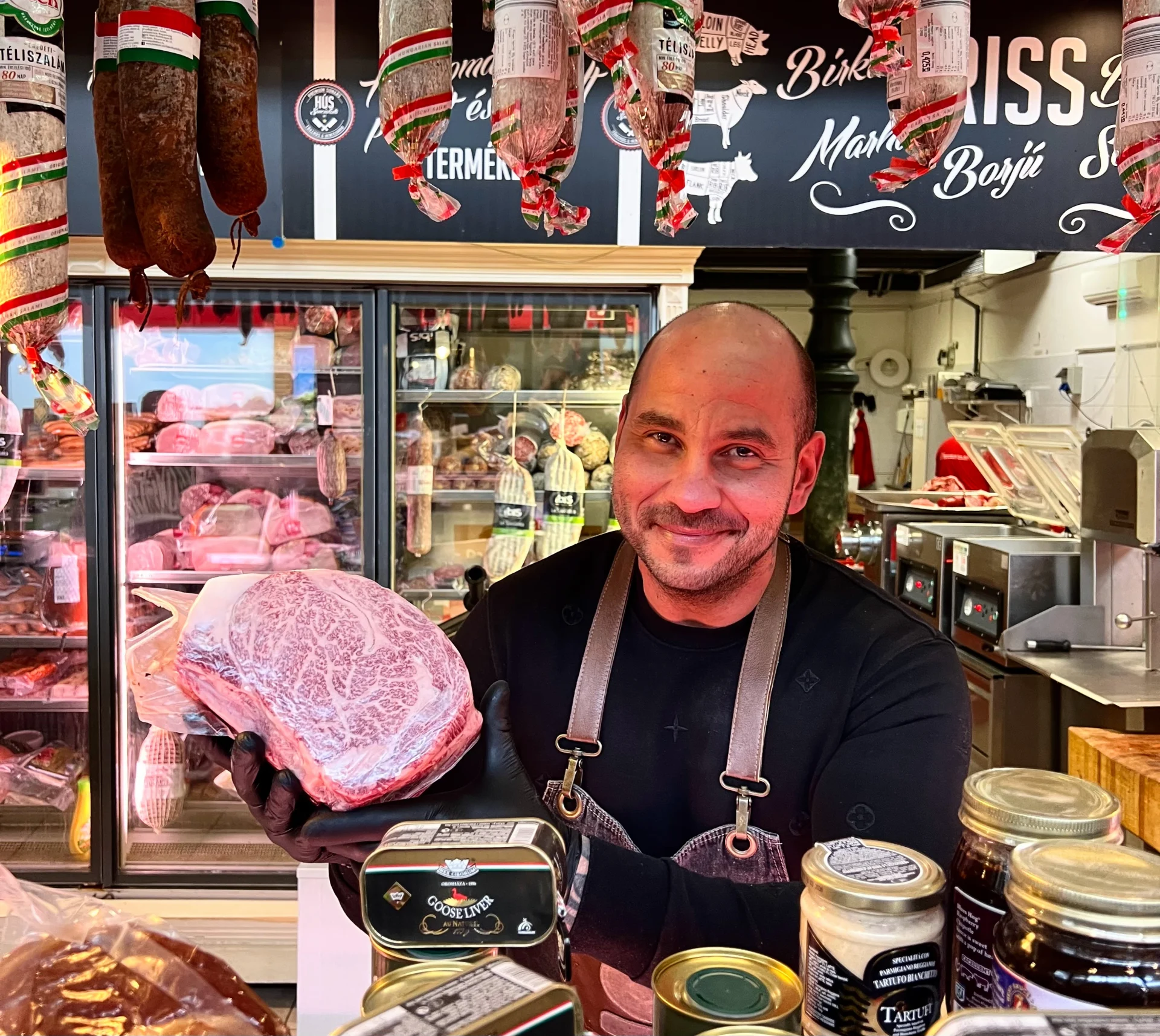
The park faces the Klauzál Market, one of the five 19th-century indoor market halls of Budapest. The market has been struggling to find long-term tenants but there are good reasons to visit it nonetheless: Krisztián, my favorite butcher in Budapest, will guide you to delicious cold cuts with charisma, confidence, and wit (tell him that I promised that he would give you a discount).

Next to Krisztián stands an excellent cheese vendor; and Marika, on the upper deck, serves made-to-order lángos, a traditional fried flatbread topped with sour cream and cheese. On Sunday mornings, a flea market occupies the premises.
Downtown may have more Michelin-decorated restaurants, but the Jewish Quarter is giving it a run for its money with its diversity of options. Within a few minutes from one another, one could enjoy excellent morning pastries at Arán, breakfast at Kaptafa, updated Hungarian food at Gettó Gulyás, fashionable vibes at Mazel Tov, Korean sandwiches at Eggi, Japanese dishes at Komachi, and kosher cholent at Carmel. The neighborhood's many glatt kosher restaurants serve mainly orthodox tourists since Budapest's Jewish community is completely secular. There are also a few Jewish-style places.

With almost every street lined with attractive-looking drinking establishments, the Jewish Quarter's saturated bar scene can feel overwhelming. I already mentioned that Budapest's most famous bar, Szimpla, anchors the Jewish Quarter. Kisüzem, imbued with bohemian vibes, managed to retain a mainly local clientele and serves a broad selection of premium rums from the top shelf. Nappali Kávéház plays in a similar league, except it is stronger in whiskey and usually less crowded. Trendy hipsters congregate at Telep and Központ on Madách tér. Fekete kutya occupies the in-between territory: part bohemian, part cool. In the outdoor season, Kőleves Kert can be enjoyable under a canopy of trees.

Gozsdu Udvar consists of a long stretch of lively bars and restaurants right in the heart of the Jewish Quarter. One should proceed with caution here, though, as Gozsdu is a favored hangout of stag parties and the type of place where scantily clad hostesses and grouchy bouncers abound. The place is worth seeing but I don't usually spend too much time or money here.
If you are serious about your drink, be it a classic martini or a contemporary Penicillin cocktail, I would point you to Boutiq Bar and Hotsy Totsy. An interesting social phenomenon: throngs of local teenagers and college students who have been priced out of the Jewish Quarter drink away happily for a fraction of the prices just blocks away at the bare-bones bars along the Grand Boulevard (Erzsébet Körút).
Many firewalls of the Jewish Quarter are covered by murals. The one next to 40 Wesselényi utca shows two Hungarian Nobel prize winners from 2023: Ferenc Krausz, a physicist, and Katalin Karikó, a biochemist. Karikó is internationally known as she was one of the scientists who developed the mRNA vaccines that provided protection against the coronavirus. She grew up in Hungary but is currently a researcher and professor at the University of Pennsylvania.

Inspired by the urban developments of Haussmann's Paris and Vienna's Ringstraße, the Grand Boulevard was built in the late 19th century to connect the neighborhoods of the Pest side. Still today, it is the city's main artery whose various sections are named after Habsburg kings and queens of Hungary. Erzsébet körút, for example, by the Jewish Quarter, is named after Queen Sisi.
The Grand Boulevard is lined with Renaissance palazzo-looking apartment buildings that were homes to the rising middle class. Around the turn of the 20th century, many of the more than 500 cafés of Budapest lined these storefronts. Unfortunately, shopping malls have siphoned away foot traffic, which is why this once truly grand boulevard appears so forlorn these days, teeming with overlit gyro vendors and second-hand mobile phone operations. It is not a pretty sight but perhaps the general re-urbanization trend of European cities will help improve this area as well.
Budapest’s New York Café has been a tourist attraction since the 1930s, but the place has never been more popular than in recent years. It is surely the most spectacular coffeehouse in Budapest, if not the whole world, but is it worth an hour-long wait and the €11 cappuccino? I can’t decide that for you, but I can lay out some facts. The New York Café occupies the ground floor of the New York Palace, an imposing building along the Grand Boulevard commissioned in 1894 by the New York Life Insurance Company to house its offices and rental apartments (today the five-star Anantara Hotel is upstairs).

The coffeehouse’s prime was the pre-WWI period, when renowned Hungarian journalists and writers such as Ferenc Molnár spent unruly nights here under the sky-high ceiling. The place continued to operate as a coffeehouse for much of the Communist period, although with a less western-sounding name (“Hungária”). After a 2006 gut-renovation, the New York Café has regained its completely unbridled interior, featuring ceiling paintings, bronze statues, gilded putti, and heavy chandeliers. I’m pretty sure it is the only coffeehouse with Solomonic marble columns and a Bernini-esque baldachin.

As with other major tourist attractions, prices are absurdly high and locals don’t go near the place. The food – Central European classics – is solid but far from memorable. Every day, a Gypsy band plays live music for fifteen minutes between 11 a.m. and 5 p.m. All this to say: the New York Café isn’t a typical tourist trap and if you are a Baroque-fan like me or after an unusual selfie, then you should probably get in that line. Otherwise, save your time and money and go someplace else.

Historically, Király utca was the main commercial street of the Jewish Quarter. It took a surprisingly long time to revive itself from its Communist-era stupor but Király utca is starting to resemble its old self again with a rising number of small stores, cafes, and bars. It helps that nice hotels are springing up on nearby Andrássy Avenue, for example the W across from the Opera House.
% Arabica is a buzzy Japanese specialty coffee chain with a striking Zsolnay-lined interior; Belvárosi Disznótoros is my go-to sausage shop in the neighborhood; Kadarka wine bar serves a wide range of Hungarian wines. Király utca is also home to Budapest's hallowed hall for classical music fans, the Liszt Academy.

Locals and tourists alike usually admire the Anker Palace, a radically eclectic yellow building that presides over Budapest’s city center where Király utca sets off. Architect Ignác Alpár piled a motley collection of elements atop one another for this rental palace commissioned by Anker, one of the oldest Viennese life insurance companies. For example, he planted an outsized pedimented portico onto the facade, a Mesopotamian-inspired structure up top, granite Doric columns around the main entrance. They surely grab the attention.

Architecture historians from their ivory towers tend to be less enthusiastic. They might tell you that the building looks kitsch, that it lacks proportions, and that it exemplifies the failure and complete misunderstanding of 19th-century revivalism. Let them think that. To me, this building embodies Budapest’s rapid rise during the period of Austria-Hungary: still a bit provincial and rough on the edges, but exuding unbridled ambition, confidence, and positivity. Bonus: there’s an excellent English-language bookstore on the ground floor of the building – Atlantisz Könyvsziget.

This takes us right to the border of Budapest's downtown, District 5, which offers its own treasures that are worth discovering.
My content is free and independent. I rely in large part on readers to support my work. I'm grateful if you make a one-time payment (PayPal, Venmo, Revolut) or subscribe to my weekly newsletter in which I write about Budapest and Vienna.