András is one of the leading urban historians in Hungary.
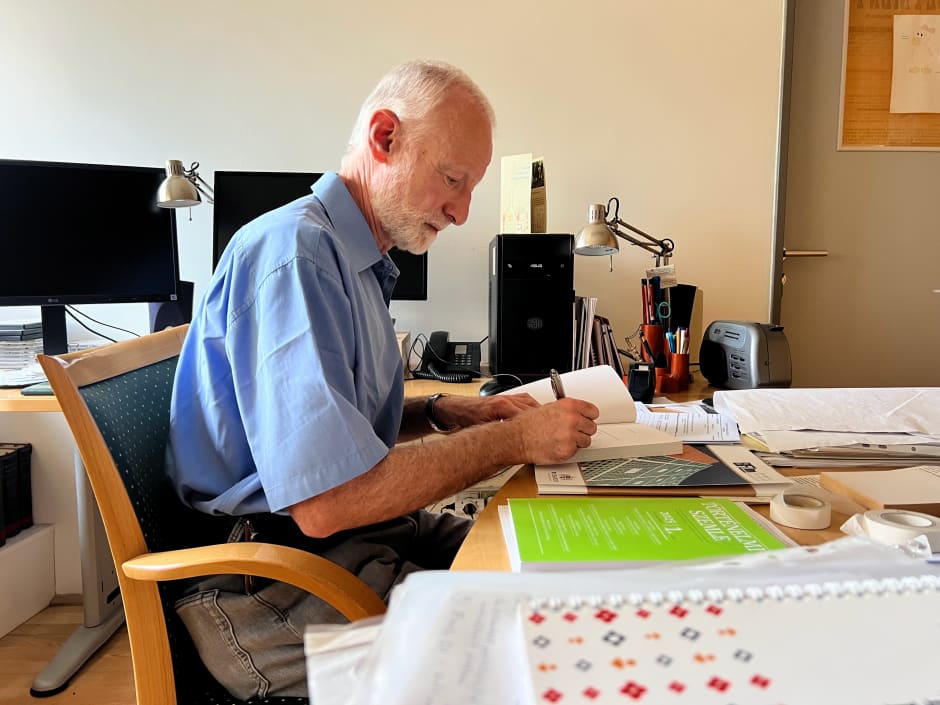
András Sipos has long been a department head at the Budapest City Archives, and he is also among the most well-known urban historians in Hungary. His research spans Budapest’s urban development, urban policy, and housing. The occasion for our conversation was a temporary exhibition at the Budapest City Archives titled “Budapest 75,” which commemorates the 1950 creation of Greater Budapest that established the city’s current borders. The exhibition can be visited for free until May 31, 2026 (note that wall texts are available in Hungarian only).
We covered many topics: the role of the City Archives; the ways in which Budapest could and could not rival Vienna after 1867; the original purpose of Budapest’s market halls; István Bárczy, the great reformer mayor; the achievements of the interwar period; the city under the Communist one-party state; and Budapest’s current challenges and its problematic municipal structure.
We are in Angyalföld, Budapest’s District 13, in the home of the Budapest City Archives, which is a surprisingly astonishing building!
The building was part of an urban renewal project, which is why it’s so spectacular – with a vast atrium and a bright, huge research area. Its 2004 opening was connected with the transformation of Váci út from an industrial to a business district, and with the transformation of the Archives itself. After the fall of the one-party dictatorship, the municipality of Budapest wanted a building that would convey that the Archives was no longer a repository of secrets, a closed-off research site, but an open and welcoming cultural center that serves the citizens. We have come a long way: I began my archivist career in 1988 in the crypt of the Saint Stephen’s Basilica, because part of the documents were evacuated to the church during WWII bombings.
What does the Budapest City Archives do?
The Archives grew out of the municipality’s own archives starting in the 18th century. Today, we are a public archives – we preserve the documents of the municipality of Budapest and documents of historical value from all Budapest-based organizations that operate without a national jurisdiction. In addition, we store documents collected from the private sector. Recently, we have been particularly focused on collecting the documents of regular people and families.
Who visits the Archives?
These days, scientific or historical research accounts for a small portion of our total traffic. Many people, for example, come here to prepare for a building renovation based on the original architectural plans or to search for legal documents. Others research the history of their family, place of residence, or local community.
What are some notable documents stored in the building?
The design plans of the office of the famous architect, Miklós Ybl, for example. No one knew about this. The documents were discovered in a hidden corner of the Basilica in the 1950s and their processing took decades. First, thousands of pages had to be scraped out of the dirt and identified one by one. The Ybl archives are now fully available on the internet. A few years ago, the archives of the early-modern architect István Medgyaszay were deposited in our institute. Their processing and digitization are currently underway and we hope that a similar virtual archive will be available soon.
Would it be possible to digitize all documents in the building?
Many people think that digitization is just a matter of equipment and manual labor. However, preparing documents for digitization in a way that researchers find helpful and matches the system of the Archives is a much bigger task than simply photographing the pages. A lot of preparation is required to avoid creating an unmanageable mass of images. Paper-based documents, for example, have been weathered by time and a lot of information disappears from a crumpled, dirty document. Currently, only 5-6% of our archives has been digitized, although this already includes the most frequently searched materials.

Let's move on to the history of Budapest. There was a famous rivalry between Vienna and Budapest during the years of the Austro-Hungarian Monarchy (1867-1918). How did this rivalry show itself?
When the Dual Monarchy was established in 1867 from the two equal halves of the Empire, the three cities that later formed Budapest (Pest, Buda, Óbuda) were not only not competitive with Vienna, but they were completely unprepared to fulfill the role of being a national capital in terms of cityscape and infrastructure.
This changed over time.
No matter how rapidly Budapest developed, in the eyes of the public achieving equality with Vienna would have meant that the ruler regularly spends part of the year here. Together with the distinguished international society that gathered around the royal court. This was not the case, since Franz Joseph and his court lived in Vienna. Still, the local elite wanted to make Budapest suitable to provide a framework for the Habsburg imperial representation, especially after 1892, when Franz Joseph made Budapest an official seat of the royal court (“székesfőváros”). This prompted the ambitious reconstruction of the Buda Castle thanks to which the palace acquired its current dimensions. When tourists view this vast complex, it is good to remember that it was never a functioning royal residence, but created out of a desire to become one.
The Parliament building, however, was very much in use.
The Parliament was built at the same time on the other side of the Danube. It was meant to embody the greatness and the constitutional will of the nation. Taking advantage of the Danube panorama, these two buildings are in a beautiful dialogue with one another and symbolize Budapest’s ambition to be an imperial center.
Andrássy Avenue also embodied this desire for representation?
Correct. Andrássy was already part of Budapest’s first major urban plan in 1870. If we look at the city’s fabric at that time, we find a rather crowded, densely built spatial environment with narrow streets and a lack of monumental squares and public parks. Even the Grand Boulevard was designed to a bare minimum compared with Vienna’s Ringstrasse. In contrast, Andrássy Avenue was made to be spectacular. Before its construction, it was widely criticized. That it was not an investment of national interest that serves Budapest’s commercial and logistical needs. And that it was money wasted on the upper class to travel to and from the City Park, which was the city's main entertainment venue.
The buildup of Andrássy was financed by the Budapest Public Works Council (Fővárosi Közmunkák Tanácsa). Was it a state or a municipal institution?
The establishment of the Fővárosi Közmunkák Tanácsa was initiated by Prime Minister Gyula Andrássy in 1870 with the intention to create an organization through which the government could channel money into the development of Budapest while keeping these urban developments under control. The municipality of Budapest delegated the same number of members as the Hungarian government, but the government had the decisive vote and it was also in charge of the administrative personnel.
How was the working relationship between the city and the Hungarian government?
The Fővárosi Közmunkák Tanácsa was really important in the first 20-25 years of its existence, while the loans secured by the Andrássy-government lasted. This money covered the costs to build Andrássy Avenue, the Grand Boulevard (Nagykörút), and the Danube’s central embankments. Over time, however, the municipality of Budapest matched and even surpassed the Fővárosi Közmunkák Tanácsa in terms of finances, planning capabilities, and knowledge, and from the turn of the century it was an open question whether it was still needed.
Károly Kamermayer was the first mayor of unified Budapest in 1873. He was in power for more than twenty years, but we don’t hear much of him.
Kamermayer Károly tér is a quiet square in the city center, free of noise and traffic. It perfectly captures Kamermayer’s personality. Kamermayer indeed served for more than twenty years, from the unification to the Millennium celebrations of 1896. We look back on the latter date as a major turning point, when Budapest finally emerged as a truly modern metropolis and a national capital.
It was a fruitful period.
The public’s perception is that this was a period of a huge upswing. It is good to remember that in 1873, when the unified Budapest was created, there was a massive Europe-wide financial and economic crisis with a devastating impact also on Hungary. For the next 10-15 years, the municipality of Budapest was mostly concerned with getting by. It was only from the mid-1880s that the situation improved. Taking advantage of the economic boom preceding the 1896 Millennium celebrations, the programs announced at the time of the unification were finally completed. Such as the construction of the water supply and sewerage system and those of the market halls.
Most of Budapest’s market halls are struggling today. Did they serve their purpose initially?
Before the appearance of indoor markets, people had to purchase groceries at makeshift, open-air markets where produce vendors laid out their products on the street. If not on the bare ground, then on blankets spread out on the ground that was littered with garbage and horse manure. Adulterated products and diluted milk were a constant problem. The main purpose of the market halls was not to make profit, but to create safe and hygienic conditions for food procurement. They perfectly served this purpose and they generated good sales, since under the new conditions, fruits, vegetables, milk, and eggs could only be sold in the market halls.
István Bárczy is the only Budapest mayor whose name marks an era (1906-1918). Who was István Bárczy?
Bárczy was the embodiment of an international mayor type – the great expansionist mayor, such as Karl Lueger in Vienna. The appearance of this type was linked to big cities, because the conflicts of industrialization and modernization concentrated in big cities. Municipal administrations responded by taking over new functions, anticipating the development of the welfare state. Bárczy not only capitalized on an economic boom, but he was the first Budapest mayor to obtain large loans from the international markets. All this, squeezed into a few years, resulted in an investment boom that was unprecedented in the history of Budapest.

What kind of developments did Bárczy undertake?
Previously, almost all public services were in the hands of monopolistic private companies, with the exception of water supply and the sewerage, which were considered public health services. Under Bárczy, the municipality of Budapest acquired the companies that provided gas, electricity, public transportation, and garbage collection. Bárczy operated them as a unified, transparent public utility. He launched a very significant housing and school construction program. He opened a municipal bread factory and a city-owned retail network, in order to reduce price pressures on the market. He gathered the best and brightest minds around him. He had brilliant political skills. Instead of positioning his reform program in opposition to the national governments, he cooperated with governments of all stripes.
Budapest’s development slowed down after WWI and the collapse of Austria-Hungary.
It was impossible to continue in the same spirit, because the Empire and the imperial market had disintegrated. The Carpathian Basin ceased to exist as a unified economic area – the flow of goods and labor suddenly faced many obstacles. Budapest could no longer take advantage of its extremely favorable position in the center of the Carpathian Basin and along the banks of the Danube.
Were there any high points in the interwar period?
Both the Hungarian state and Hungarian society became impoverished. Fewer resources were available for big urban developments, spectacular public buildings, cultural investments, and social programs. The few highlights include Margit körút and its modernist housing stock which were entirely the result of developments in the 1930s and 1940s. The development of the Buda Hills as a residential area – a neighborhood with villas and apartment buildings for permanent residence – also falls into this era.
It is a common phenomenon that the inner city gradually expands and absorbs its outlying areas. Greater Budapest was created only in 1950, although it had been in the making for many decades (Greater Vienna was formed already in 1891). 75 years hence, how successful was the integration of the newly annexed areas, such as Újpest, Rákospalota, Kispest, and Budafok?
It is a common belief that the Greater Budapest area was determined on political grounds, and that it was a megalomaniac creation of the Rákosi regime. That certain areas, such as Rákos, were annexed to Budapest only because they wanted the city to be as big as possible. There is no basis for this. The Greater Budapest area was made fully in line with previous proposals.
What were these proposals?
The idea was that not only areas that have already reached a certain size and level of urbanization, such as Újpest, should be annexed to Budapest, but that reserve areas were also needed. So that Budapest could have its own residential suburbs and greens within city limits. Areas such as Rákos and Pesthidegkút were intended for this. The problems didn’t come from this.
Where did the problems come from?
In the 1950s, Greater Budapest began to operate within the framework of a centrally controlled command and war-economy. The newly annexed outer districts did not catch up to the inner city, which itself started to decline. The whole problem was that municipal self government completely ceased to exist during the one-party dictatorship. Districts did not have their own property and their own income. They managed what was allocated from above. Local considerations were always inferior to the “national economic interests.”
Can you give an example?
The large prefabricated housing estates in places like Újpalota or Békásmegyer. They completely contradicted previous urban plans. They were erected not because it was reasonable from an urban planning perspective, but because this was the easiest way to achieve the targeted number of new apartments set at the national level. So the state-owned construction industry built a huge, continuous housing estate where it was most convenient.
Based on today's urban planning principles, it is not necessarily a bad thing that a densely populated area sprung up outside the city center.
Earlier urban planning ideas also envisaged the development of such hubs outside the center, but they were supposed to be embedded in greenery. Also, after so many decades, to what extent do these housing estates form a real city center today? They are connected to the city center by an umbilical cord.
Many Western European cities today coordinate and develop the urban infrastructure at the agglomeration level. One example would be the Grand Paris Express, which builds the suburban metro lines in Paris. What’s the situation in Budapest?
It is also for this reason that the sudden abolition of the Budapest Public Works Council (Fővárosi Közmunkák Tanácsa) in 1948 was a painful mistake. It would have been an ideal platform to manage the planning, building regulation, and transportation issues of Greater Budapest and its outskirts. This has been missing ever since, although many things have been tried since 1990. As far as I know, there is no municipal or state entity currently focused on this, which is evidenced by the problems of Budapest’s commuter towns.
What are the problems of the commuter towns?
There aren’t enough public transportation options into Budapest. This results in a huge flood of cars rushing into the city each morning. And the commuter towns are parceling up land for residential development in areas without good public transportation. Their public utility systems are overloaded. And since every local government has been developing land simply based on its own needs, Budapest is running out of precious green spaces. The political and economic interests constantly override long-term considerations.
After the fall of the Communist regime, municipal governments were restored in Hungary in the 1990s. In fact, a unique municipal system was created in Budapest, where each district operates as a completely independent local government.
Budapest has 23 districts and the district-level local governments have absolutely no hierarchical relationship with the municipality of Budapest (Fővárosi Önkormányzat). They have the same legal status as the municipality of Budapest, but they perform different tasks. For example, the municipality of Budapest is in charge of the main roads, public transportation, utilities, public parks, and bridges. All other roads and public services fall under the local district or sometimes the state. This is typically not the case in other European cities. In Vienna, for example, the districts aren’t independent, but subordinated units of the municipality of Vienna.
What was the original idea behind creating independent districts?
A line of thinking after the fall of Communism was that very strong self-governance would bring local politics closer to the people and instill a sense of democracy that could then be transposed into the national level. As far as I can see, this was wishful thinking. District-level governments appear as amorphous political entities flying way over the head of people.
This is why it is so difficult to implement decisions in Budapest at city-wide level.
The fact that each of Budapest’s 23 districts is an independent political-economic unit with its own representative body creates a decision-making jungle. For example, there was recently a public debate about pedestrianizing some streets in Erzsébetváros (District 7) and Ferencváros (District 9). A takeaway of the public discourse was that it is extremely difficult to even ascertain whether this issue falls under the jurisdiction of the local district or the municipality of Budapest.