Away from the fashionable parts of the lake, Keszthely is the cultural capital of Balaton and packed with treasures.
Often referred to as “Hungary's Sea,” Balaton is Central Europe’s biggest lake and the number one summer destination for local people. For hundreds of years, Balaton was a sleepy region of vineyards and fishing villages before transforming into a mass resort prompted by the 1861 completion of the railway that connected the lake with Budapest. Today, vacation homes and beaches line Balaton's 200-kilometer (125-mile) shoreline. Things quiet down in the off-season, from October to April, when Balaton has its own charm.

Keszthely and the Festetics legacy
Historically, Balaton's one sizable town was Keszthely, at the westernmost end of the lake cradled by the Keszthely Hills. The development of medieval Keszthely came to a temporary halt when the Ottoman army advanced into southern Hungary. Although never conquered as nearby Nagykanizsa, Keszthely stood right on the military frontier between the Ottoman and the the Habsburg armies throughout the 16th and 17th centuries, which hindered its progress and transformed the city into a defensive fortress.
Keszthely's downtown is still anchored by a vast 14th-century church whose sanctuary is decorated with the biggest Gothic fresco cycle in all of Hungary. The clumsy scenes of the life of Jesus and the Virgin were discovered in 1974 during a routine renovation. 19th-century additions include the Gothic Revival bell tower and the stained glass windows made in the renowned Budapest atelier of Miksa Róth (find his signature on the bottom of the panes). The church can be accessed for free.
To the right of the high altar is the red marble wall tomb of Keszthely's (and Hungary's) most powerful medieval feudal landlord: István Lackfi. When Lackfi's wealth and power started to rival that of the King of Hungary – Sigismund, later also Holy Roman Emperor – he thought it prudent to get rid of Lackfi, doing it in characteristically medieval fashion in 1397.

The church has another important funerary monument to the left of the altar: the marble Rococo pyramid attached to the wall contains the remains of the first member of the family whose name has become synonymous with Keszthely – the Festetics. It was a turning point for the city when in 1739 Kristóf Festetics became the feudal landlord and established Keszthely as the center of his dominions.

Enjoying the support of the Habsburg court, the Festetics, originally from Croatia, was among the wealthiest families in the Habsburg Monarchy with 170,000 hectares (420,000 acres) of land across western Hungary. They were self-interested feudal lords but the ideas of the enlightenment inspired some of their members to meaningfully contribute to Keszthely's development. Take the case of György Festetics (1755-1819). After a fallout with the Holy Roman Emperor, he left Vienna and moved back to Keszthely in 1791 where he set out to transform the city.

He built schools, a hospital, a printing press, and supported local artists and businesses. He funded countless scholarships and research studies. He extended the Festetics Palace with a stunning Neoclassical library (1801) which he made available to students and researchers. According to a somewhat obsequious 1817 poem by the famous poet, Dániel Berzsenyi, who also got money from György, Festetics turned Keszthely into the "Weimar of Hungary."

György Festetics commissioned the biggest ever sailing boat of Balaton, the Phoenix, with the goal of linking the lake into the commercial orbit of Hungary. He was the first to develop nearby Hévíz, a large thermal lake available for swimming and still a popular healing resort today. In 1797, he founded the Georgikon, the first academy of agriculture in Europe. He gave the school farmland, forest, and vineyards for education and research. Soon, the Georgikon earned a reputation across the Habsburg Monarchy whose aristocracy hired its estate managers from the academy’s graduates.

The Revolution of 1848 wiped out the institution, which started anew in 1865 and continues to be an important university for agricultural sciences. The Georgikon's original training facilities house the Georgikon Museum today, a sister institute of Budapest's Museum of Agriculture, with a rich collection ranging from the world’s first tractors to artifacts about winemaking, farming, and village life.

I especially like the ornate 19th-century winepresses and the taxidermied examples of Hungary's native animal species such as the Racka sheep, the Hungarian Gray cattle, and the Mangalica pig. Helpful bilingual wall texts appear throughout. Recently, the museum added a child-friendly model garden and animal farm where people can try to differentiate various field crops and say hello to domestic animals.

The Georgikon academy's vineyards were located in Cserszegtomaj, a village outside Keszthely. Today, more than 220 years later, the same parcel of land still belongs to the university’s winery (Georgikon Winery) where professors and students cultivate more than 300 grape varieties and experiment with new clones. In fact, one of Hungary’s most popular wines, the Cserszegi fűszeres, was developed in Cserszegtomaj in 1960 by the legendary professor, Károly Bakonyi, and took its name after the village.

Cserszegi fűszeres is a cross between the aromatic Gewürztraminer and the savory Irsai Olivér grape varietals. I always pile up on Georgikon wines for the summer season; they are delicious, affordable, and sell out quickly. The university's winery is located at 39 Porkoláb utca and can be reached at +36304732909. It's also possible to order deliveries throughout Hungary.

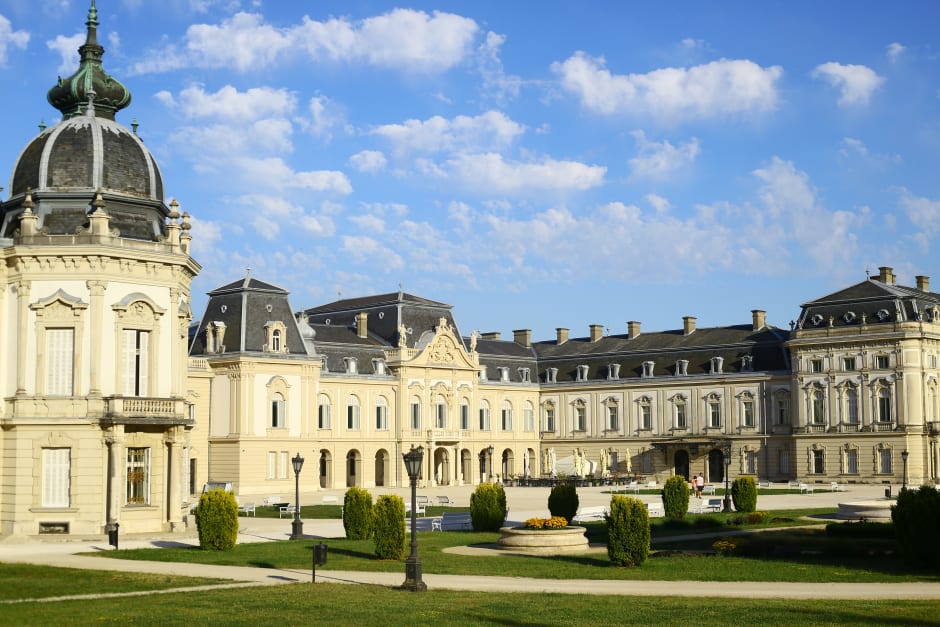
Presiding over Keszthely, the enormous, 101-room Festetics Palace functions as a museum currently. In its heyday, the European high society gathered here, including the Prince of Wales, Crown Prince Rudolf, and Habsburg Archduke Franz Ferdinand, whose later assassination triggered World War I. The jaw-dropping halls were decorated with Teniers-goblins, Canova-statuettes, oversized Meissen porcelain vases, and paintings by Hubert Robert, Peter Krafft, Franz Xaver Winterhalter, and Gyula Benczúr. Furniture and lighting fixtures were sourced from leading Parisian and Viennese manufacturers. The most valuable piece was a Boulle desk, made from layers of tortoiseshell, brass, and pewter (André-Charles Boulle was the cabinetmaker of Louis XIV).

Together with the library, most of these items escaped WWII looting thanks to a small miracle: the General of the invading Soviet army, the Ukrainian Ilja Illarinovics Sevcsenko, appreciated the immense cultural value of the Festetics palace and prevented his troops from ravaging the building. He walled off the most precious objects and put up a “contagious diseases” sign. Decades later, in 1985, Sevcsenko was made honorary citizen of Keszthely.

After WWII, the Hungarian state confiscated and nationalized all Festetics property in 1945 and the Festetics family fled to Austria before the Communist takeover. Today, the palace's manicured park and English garden are open for all to explore. In addition to the palace museum, the estate grounds also house the horse carriage museum inside the old Festetics barn; a model railway exhibition; the hunting museum; and the palm house.

The latter is the Gustave Eiffel-produced Festetics greenhouse which now inhabits a range of tropical and Mediterranean plants and cacti. For small children, there's a modern play space all the way in the back of the palace-park in a Swiss-style chalet that used to be the Festetics's dairy house. One of the last heads of the Festetics clan was Tasziló II (1850-1933), a cartoonish figure in his reverence of the Habsburgs and fondness for horse racing. After the 1918 collapse of Austria-Hungary, he made a point of snubbing Miklós Horthy, Hungary’s leader between the world wars: Horthy wasn’t allowed to take the grand mahogany staircase of the palace, being too lowly of birth.

Tasziló married Mary Victoria Hamilton, daughter of the Duke of Hamilton and the ex-wife of Albert I, the Prince of Monaco (this makes her the great-great grandmother of the current Prince of Monaco, Albert II). Some of the most precious possessions of the Festetics Palace came from England, after Lady Hamilton settled in Keszthely where she went on to live for more than forty years.

The couple’s exuberant funerary monument, one of the first reinforced concrete structures in Hungary (1925), still towers over Keszthely’s St. Nicholas cemetery. Another reason to visit this charming cemetery is the oldest building of Keszthely. The late-Romanesque style Saint Nicholas chapel, in the middle of the graveyard, features a 14th-century fresco cycle on its outer wall. Similar to the fresco in the main church, this one was discovered during a recent restoration. Of the six figures, most dramatic is Saint Bartholomew, with knife in hand and carrying his own skin on a pole to evoke his gruesome martyrdom.

Back to Tasziló. His lavish cattle barn and horse breeding farm in Fenékpuszta, outside Keszthely, was home to a collection of renowned thoroughbreds and the wonder of foreign visitors. Today, the nicely restored Neoclassical facilities feature a cafe and exhibitions about horse races, but the complex's long-term prospects seem uncertain.

Across from the manor house lie the traces of Valcum, the late-Roman fortification built in the 4th century CE to protect the road to Italy from regular attacks by Germanic tribes. The fortress contained a small town complete with several temples and a palace, but later generations used it as construction material which is why the remains are hardly visible today (the Balatoni Museum, see below, includes precious archeological findings).

No one can blame Tasziló and Princess Mary for lacking good taste: they commuted between the palace and the horse farm through a hauntingly beautiful, six-kilometer (four-mile) allée lined with black pines, today a hangout for dog owners.
More things to do in Keszthely
In 1950, around the beginning of the Communist period, the county borders and public administration around Lake Balaton was completely reorganized. After a thousand or so years, the Balaton Uplands and Keszthely were detached from Zala County and became part of Veszprém County. Supposedly, this happened in order that the Balaton region be split between just two, rather than three counties (Veszprém in the north and Somogy in the south).
Keszthely was a victim of this redrawing of county-borders, because cities that were closer to the new county seat of Veszprém, such as Balatonfüred and Tihany, got more attention and development funds. Keszthely became a faraway stepchild of Veszprém County. This decision was finally reversed in 1978, when Veszprém's powerful Communist party leader, János Pap, lost influence, and Keszthely – but not the rest of the Balaton Uplands – returned to its ancestral home, Zala County.
Keszthely’s post-Communist history – after 1990 – hasn’t been a success story. The city used to be a bustling summer destination for East German tourists but today affordable vacation resorts in Spain or Italy offer more allure. Also, it's too far for the well-off Budapest crowd which prefers the more accessible parts of Balaton (Keszthely takes two hours to reach by car). Unattractive storefronts accost strollers of Kossuth Lajos utca in downtown, and the two historic hotels facing the lake, Hullám and Balaton, are in an embarrassing state of disrepair.

Despite Keszthely's challenges, I’m still drawn to this beautiful and culturally rich city. There’s much to explore even beyond the Festetics legacy. The Amazon Museum, for example, which portrays the nature of travel around the turn of the 20th century with a focus on the golden period of rail travel. The spectacular Balatoni Museum, with an engaging exhibition about the lake’s formation, geology, wildlife, folk art, and recent history. A giant mammoth bone found near Balaton in the Pleistocene; Roman-era jewelry; the tools of fishermen, for example. The last few halls deal with the gradual resortification of Lake Balaton. No one should miss it.

I am a regular on Wednesday and Saturday mornings at Keszthely's farmers' market, which hasn't yet morphed into a hipster apocalypse. Here, I get my seasonal fruits and veggies, homemade paprika spreads, and paprika sausages from the mangalica farmer, Istvándy. The mysterious Helikon Park, always dim and melancholic because of the towering chestnut trees, is anchored by a memorial to György Festetics and the Helikon literary festival that he founded. The park is ringed by the villas of Keszthely's upper-middle class from long ago.

If you are a horseback rider or would like to become one, head to the Georgikon University's horse stable to schedule a riding lesson or pet the horses (booking via +3630 315 5545). That gorgeous Festetics pathway (allée) lined with black pines passes through here and advanced riders can take a trail ride through it.

Along the way, one will pass the house, overgrown by ivy, where Béla Bartók stayed in 1906 while collecting folk songs. Across from it stands the building where Júlia Szendrey grew up; she was the wife of the famous romantic poet, Sándor Petőfi, and herself a poet and intellectual (Júlia's father was an estate manager for the Festetics after graduating from the Georgikon). For better or worse, most of these places don’t come with conspicuous signs, but a sense of discovery is part of the fun.
I will take this opportunity to brag about the fact that I was on the Hungarian national tennis team for several years and during summers spent in Keszthely I had an amazing and colorful tennis coach, Ernő Polozgai. Ernő is still the coach at the Helikon Tenisz Club, with four panoramic courts just steps from the lake. Feel free to stop by and schedule a private lesson with him or reserve a court for yourself (Ernő is reachable on +36 30 386 4099).

Keszthely was the first city in Hungary to erect a memorial to the victims of the Hungarian Revolution of 1956. When the revolution was crushed, this makeshift object had to go, of course. In 2006, Keszthely raised a permanent monument to evoke both the events of the revolution and the old memorial. It was the sculptor Lajos Orr who made a gently contextual sculpture that is also in dialogue with the church on the main square outside which it stands (Lajos Orr is the father of Máté Orr, the renowned neo-surrealist painter).

Incredible sunset views can be caught from the Szent Mihály chapel, a small hill overlooking the lake in the nearby village of Vonyarcvashegy. A ten-minute uphill hike is required to enjoy the vistas. I wouldn't blame you if you brought along a chilled bottle of wine or some beers and you also wouldn't be the only person to do that.

The little shopping I do is at the craft potter in Gyenesdiás, J&A Kerámiaház. Operating out of three old peasant houses, the family has been selling folklore-themed vases, bowls, mugs, and trinkets since the early 1990s. There's a small exhibition of miskakancsó, 19th-century jars resembling a Hungarian Hussar, complete with a conical hat and handlebar moustache (they also sell them).

Keszthely has two antique stores where my mother and I like to get lost in search of Biedermeier furniture, Keszthely memorabilia, and all sorts of stuff we don't need. Much of Balaton was and still is a wine-growing region; Keszthely's best wine store is Pampetrics, specializing in regional wines including those by Georgikon in case you can't make it to the university's vineyards in Cserszegtomaj.

An idiosyncratic group of museums
Seven somewhat controversial private museums cluster steps from one another on Keszthely’s main street. They are all owned by the self-taught sculptor, Tibor Török Túri, whose somewhat kitschy ceramic busts are sprinkled throughout Keszthely. Still, his quirky museums are kind of fun.

The Horror and the Erotic museums are most popular, but there’s one about folk clothing, one with Török Túri’s renditions of Hungary's historic figures, one with a sea of children’s toys, and one with nostalgic items from the Communist period. Most impressive is the “snail parliament,” a replica of the Hungarian Parliament building; it is the labor of a woman who spent 14 years patiently assembling millions of fossilized snail shells. You might want to buy the combined ticket and quickly stop by some of the museums.
Keszthely's Jewish past
Accounting for ten percent of the population, Keszthely had a thriving Jewish community before the Holocaust. A large share of Keszthely's doctors, lawyers, and merchants were Jewish, for example. Keszthely's most famous Jewish offspring was the composer Károly Goldmark whose birth house is a charming medieval residential building along the main street. Goldmark's brother, Joseph, who emigrated to the United States, became a famous physician; his daughter married Louis Brandeis, the first Jewish member of the Supreme Court.

Tragically, nearly all of Keszthely’s Jews were deported in 1944 and killed in Auschwitz, a total of 829 people. Only sixty people survived, many of whom never returned to Keszthely. Apart from the personal tragedies, the loss of Keszthely's Jewish community had a devastating impact on the city itself – its polity, commerce, and culture.

The dilapidated tombstones and crumbling yellow funeral home of the Jewish cemetery, on the outskirts of town, stand as poignant reminders. Keszthely's synagogue hides in the courtyard of the Goldmark-house. The original synagogue was commissioned by György Festetics in 1780; the current interior bears adorable Judeo-Art Nouveau details and heart-breaking memorial plaques. The congregation currently has about thirty members and holds regular Shabbat services in the neighboring prayer room. To access the synagogue and the cemetery, call +3683 312188.
Restaurants, cafes, and beaches in Keszthely

While one can find new-wave establishments such as Madárlátta Pékség and Pajti for specialty coffee and morning pastries, Keszthely is largely devoid of the trendy places that crowd hotspots such as Balatonfüred and the Káli-medence. Fine with me. I often pick up pastries at Hosszú Pékség, where many people in Keszthely start their day. The cabbage strudel is remarkably tasty.

For unfussy traditional dishes I go to Tompos Étterem or to Öregház Vendégudvar in the neighboring village of Vonyarcvashegy. The latter serves tasty fogas (pike-perch), dödölle (a gnocchi-like dish), and Kaiserschmarren out of an updated farmhouse with cane roof (Tompos is open year-round; Öregház only in the summer). For a well-made halászlé, the local paprika-laced fish soup, I head to Halászcsárda, a long-standing restaurant in Keszthely. For Naples-style pizza: Piccola Napoli. Excellent and somewhat pricey pastries can be had at Móni Cukrászda in the village of Gyenesdiás, and at Tulipán Kávéház in Keszthely; for delicious ice cream, make your way to Retró Fagyigyár.

For a celebratory meal, I visit Zenit Balaton, the gleaming white Neoclassical building that used to be the Festetics winery. If it isn't too cold outside, I ask for a table under the columnar porch and take full advantage of the open Balaton vistas. Every year, they recreate some dishes that used to grace the dining table of the Festetics family – shrimp paprikash sourced from the Zala River? Yes, please.

I also like to dine at unpretentious food vendors (büfé) that line the beaches (strand) and serve food from flimsy wooden sheds. I go to the Gyenesi Lidóstrand or to Libás and my go-to orders are lángos, a flatbread topped with sour cream and cheese, and palacsinta, crepes filled with fruit preserves or túró. Occasionally, I order a hekk, a popular fried fish made, ironically, from a saltwater species imported from the Mediterranean (large-scale fishing in Balaton is banned).

Near the entrance of Keszthely's main strand lies Csaba Borozó, my go-to joint for a fröccs, the local wine spritzer in Hungary. It's a modest outdoor tavern patronized by local academics, intellectuals, and alcoholics in search of low-priced drinks.

Keszthely's iconic hotel
The monumental Helikon Hotel has been a pride and an icon of Keszthely since its 1971 opening. Back then, it was the city's first large-scale (socialist) modern building fitted with luxury amenities; for example, my mother would use the telephone booth in the hotel's lobby to make calls to Budapest. The hotel drew Communist party elites and Western tourists with its panoramic Balaton-views and private beach-island: to keep the shoreline accessible to the public, the hotel instead built a small peninsular land into the lake.

Today, after a recent gut renovation, the four-star-superior hotel is once again Keszthely's most upscale accommodation with astonishing vistas (every room faces the Balaton), a private spa, tennis courts, parking, children's rooms, and a full-service kitchen.

Kis-Balaton
Beautiful nature hides near Keszthely. Kis-Balaton, which translates to “Little Balaton,” is a floodplain on the southwestern edge of Lake Balaton, a swampy marshland lined with reeds, islands, and river streams formed by the Hévízi-csatorna and the Zala River, the latter the largest tributary of Lake Balaton. The Kis-Balaton came to be known for its astonishingly rich bird species, especially great egrets (nagy kócsag).
Misguided land developments transformed the Kis-Balaton into farmland by 1940, but this agricultural use had a harmful effect on the water that deposited into Lake Balaton at the Bay of Keszthely, causing a rapid growth of algae. To stop this, the Kis-Balaton reverted to its old function starting in 1985: two new reservoirs re-flooded the area that today once again naturally filters the Zala River and provides habitat to more than 250 types of birds, countless fish, and wildlife.

Much of Kis-Balaton’s 15,000 hectare (37,000 acre) is a protected nature conservation, with only a few parts accessible to the public. The bigger of the two reservoirs, Hídvégi-tó, contains a picturesque island, Kányavári-sziget, with a hiking trail. The sleek Kis-Balaton Visitor Center offers a short exhibition about Kis-Balaton, also in English, and a 30-minute video with spectacular overhead shots taken during its various seasons. This visitor center is open from April to October.

Nearby Zalavár is for those into history. Zalavár was the seat of Pribina, a Slavic ruler in the 9th century CE, who was entrusted with Lower Pannonia by the King of Germany. With the help of Cyril and Methodius, Pribina spread Christianity among his subjects, hence the bronze sculptures of the missionary brothers. Hungarian tribes soon conquered the land and King Stephen founded here in 1019 a Benedictine monastery and church whose stone remains are visible. There’s also a striking exhibition building designed by Imre Makovecz, who pioneered Hungary’s organic architecture in the late 1960s. A short drive leads to the buffalo farm in Kápolnapuszta and the folk art memorial house in Vörs, both of them enjoyable with children.
Reaching and getting around in Keszthely
It takes about two hours to drive from Budapest to Keszthely, most of it via highway. I usually travel by train, which takes 2.5 hours and also features a comfortable dining car and Balaton-views. There are several daily direct train services between Budapest's Déli pályaudvar and Keszthely's main station. You could buy your ticket at the ticket office or through the MÁV app (App Store; Google Play).

The most convenient and enjoyable way to get around Keszthely is by bicycle. The places I recommend above are in or easily within biking distance of Keszthely and there’s a full-circle bike trail around Lake Balaton. (Unless you are a professional biker, you would probably need a car to get to the Kis-Balaton.) You could rent a bicycle at GreenZone Kerékpárüzlet, a longstanding bike rental and repair shop in Keszthely's city center.
My content is free and independent. I rely in large part on readers to support my work. I'm grateful if you make a one-time payment (PayPal, Venmo, Revolut) or subscribe to my weekly newsletter in which I write about Budapest and Vienna.