The former royal palace contains paintings and sculptures by Hungary's leading artists.
The National Gallery’s first standalone exhibition opened in 1928, around the time when museums across Europe separated contemporary art from the Old Masters. It wasn’t until 1957 that the institution was officially established, and until 1975 that the National Gallery moved into its current premises on the Castle Hill.
Today, visitors can survey how Realism, Naturalism, Symbolism, Impressionism, Fauvism, Cubism, Expressionism, Surrealism, Pop art, Minimalism, Concept art and other movements showed themselves in Hungary. There’s also a smaller Gothic and Renaissance section and an international hall anchored by Courbet’s Wrestlers beside works by Monet, Cezanne, Gauguin, Bonnard, Baselitz, Hantaï, Vasarely, and others.
The royal castle, of course, wasn’t designed to be a museum. The building lost its original purpose with the 1918 dissolution of Austria-Hungary and once more after WWII, until which time Admiral Miklós Horthy lived in the palatial halls. Allied bombings destroyed the building in 1945 and the ensuing Communist regime knocked down even the salvageable elements out of a misguided sense of anti-royalism before turning the castle into a cultural complex, housing the National Gallery, the Széchényi Library, and the Budapest History Museum.

While the castle’s exterior skeleton remained, the inside came to reflect the late-modern design trends of the day. First-time visitors are often surprised to find decor-free halls fitted with unadorned red-limestone surfaces and diamond-shaped lighting fixtures. I regret the spaces that were lost during the war, but I also enjoy this 1970s Socialist Modern interior, one of the few large-scale examples of its kind.

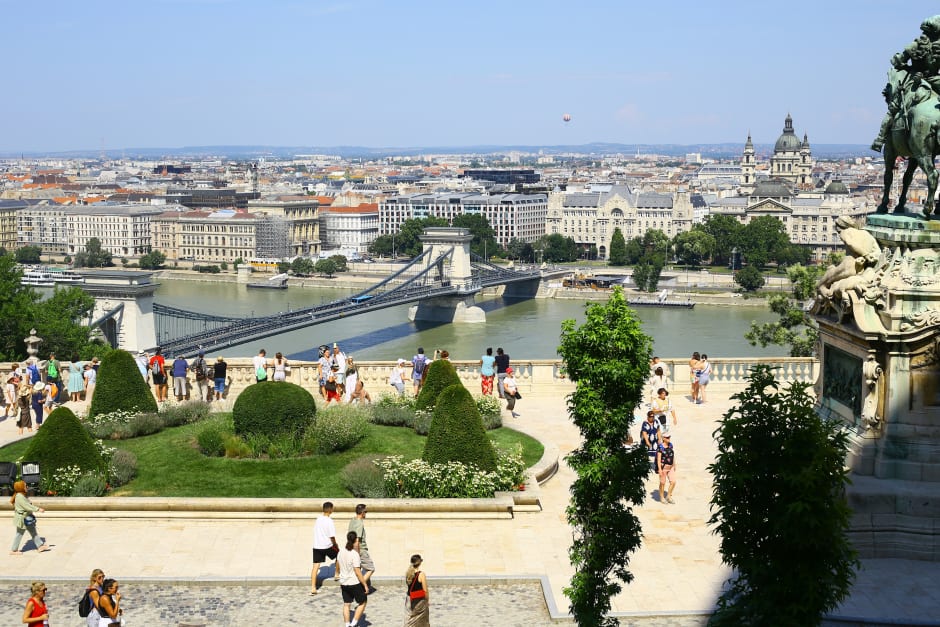
As you roam the halls, don’t forget to occasionally peep out the windows. Even better: take in the sweeping views from the cupola up top, accessible with the general admission ticket, or from the castle’s panoramic balcony that doubles as a cafe during the outdoor season. Finally, if you are also into the Habsburg legacy, you might want to visit the Habsburg burial chamber in the museum's basement. There rests Archduke Joseph (1776-1847), the longtime Palatine of Hungary, alongside his family (advance booking via +36 20 439 7325).


1. Portrait of Matthias Corvinus and Beatrice of Naples, by Benedetto da Maiano (1476)
The 15th-century reign of the Renaissance King, Matthias Corvinus, was one of the great periods in Hungary for the arts. Through his Naples-born wife, Beatrice, Matthias commissioned works from leading Italian architects and painters (Andrea Mantegna’s royal portrait has been lost, sadly) and he even imported cooks from Italy, which is why pasta spread early and deep into Hungarian kitchens.
Above, the naturalistic marble reliefs show the dignified royal couple facing one another against a backdrop of dark serpentinite. The work is by the hand of Benedetto da Maiano, better known as the architect of the imposing Strozzi Palace in Florence. Da Maiano made these as a wedding gift to the 1475 union of Matthias and Beatrice; you will need to pass through the gift shop, at the left of the ticket office, to reach the Renaissance section of the museum.

2. Little Shepherdess, by István Ferenczy (1822)
“The Hungarian Canova” is how sculptor István Ferenczy (1792-1856) is remembered today, with characteristic national pride and exaggeration. Ferenczy studied at the Academy of Fine Arts in Vienna before deciding to go to Rome to learn from the best (he was so poor that he walked to Rome). Canova said no, sending him to Bertel Thorvaldsen’s workshop, but Ferenczy was relentless and Canova later hired him. After six years in Rome, the ambitious Ferenczy returned to Hungary in 1824 and set out to reform the country’s sculpture-making. He organized a workshop, traveled the country to identify the best sources of marble, and initiated the foundation of an art academy.
Ferenczy didn't entirely live up to his own or his country's expectations, but did create some wonderful sculptures. Exceedingly elegant, the Little Shepherdess is Ferenczy’s greatest work, showing the moment when a graceful young woman draws into the sand the face of her lover who goes away (observe the base). Ferenczy donated this Neoclassical piece to the Hungarian nation.

3. Pigeon Post, by Miklós Barabás (1843)
“Biedermeier” refers to a style of painting and interior design that was widespread in Central Europe in the first half of the 19th century. In terms of brushwork, the Biedermeier adopted the controlled elegance and highly finished surfaces of French Neoclassicism, but its choice of subject matter was more lighthearted in order to appeal to the growing market of middle class buyers.
The beautiful young woman above embodies these middle class values: a Bible lies on the table beside her while she’s preparing to send off a love letter with a white pigeon, a symbol of her chastity. Miklós Barabás was the leading painter of the period, known for his sweet and sentimental genre scenes (he rarely trespassed into kitschy territory) and wonderful portraits of politicians which you will also find in the museum.

4. The Emir of Lebanon, by József Borsos (1843)
With the ease of travel, many artists from Europe visited North Africa and the Middle East between the 1830s and 1870s, producing so-called “Orientalist” paintings that depicted a romanticized and exoticized world untouched by modernity. The greatest practitioner was the Frenchmen Jean-Léon Gérôme.
The portrait above shows the Hungarian aristocrat, Count Edmund Zichy (1811-1894), cloaked in a magnificent Turkish folk dress. Few painters could rival József Borsos in rendering finely finished garments and exquisite textures. At the time of romantic nationalism, Hungarian people often flaunted their eastern ancestry – in opposition to neighboring Germans and Slavs – which might explain this unusual portrait setting. Nonetheless, Zichy was a great patron of the arts and no nationalist: he co-founded Vienna’s Museum of Applied Arts and collected Old Master paintings that currently hang in Budapest’s Szépművészeti.

5. The Wrestlers, by Gustave Courbet (1853)
One of the famous works of the gallery is by the Father of Realism. Courbet (1819-1877) rejected the French academic system and its focus on idealized forms, preferring to depict common people on huge canvases that were normally reserved for history and mythology paintings. Here, two wrestlers struggle with one another in a Paris racetrack. Instead of the polished male bodies that Salon visitors were used to, we see bulging veins, rough hands, and a loose finish. Conveying his social commitment, Courbet reduced the urban middle-class crowd in the back to a blurry mass. To fully appreciate the painting’s novelty, keep in mind that Courbet made this in 1853!

6. Women of Eger, by Bertalan Székely (1867)
The Romantic history paintings ushered in by Gerricault and Delacroix in the 1820s enjoyed lasting success across Europe through the 19th century. These pictures, often in large format, show heroic scenes from national history with exaggerated pathos. Bertalan Székely (1835-1910), a great practitioner of the genre, transports us to the 1552 siege of Eger, in northeastern Hungary, which is under attack by merciless Ottoman troops. We are placed in the thick of the action – turban-wearing Turkish soldiers fall into the abyss by the hands of the outnumbered but fearless Hungarian women presiding over the castle walls (local women indeed partook in the battle). Those feeling inspired by the painting should pay a visit to the city of Eger whose castle still stands.

7. Bust of János László Pyrker, by Miklós Izsó (1870)
A boring statue of some random archbishop? I don’t think so! The Hungarian-born János László Pyrker (1772-1847) was an impressive person: from a humble beginning, he rose to become Patriarch of Venice while pursuing a career as a writer and collecting artworks. He also revived the city of Eger and was a model figure of the Enlightenment. Pyrker didn’t care for nationalism, instead prioritizing the public good across the Habsburg Monarchy. His marble bust above, by Miklós Izsó, perfectly captures the personality of this reserved but determined intellectual. Let me also recommend Izsó's most famous work, located on the first floor of the museum: the expressive Sad Shepherd, who in fact is not so sad.

8. Picnic in May, by Pál Szinyei Merse (1873)
A modern theme rendered with bright and delicate colors and broken brushstrokes – Picnic in May is the essential Impressionist painting in Hungary. Pál Szinyei-Merse (1845-1920) made this in 1873, soon after Impressionism got started in Paris in the late 1860s. We see a group of friends lying in the shade of a large tree and enjoying the late-spring weather.
Similar to the works of his French peers, Picnic in May was ignored and ridiculed, prompting Szinyei Merse to revert to a traditional academic style (realism). Ironically, two decades later, when younger artists re-discovered the painting, Szinyei Merse was hailed as a visionary and appointed head of the Academy of Fine Arts in Budapest. (Szinyei Merse's color palette is even more striking on the sketchy "Drying Clothes" from 1869, usually on the left of this one.)

9. Milton Dictating Paradise Lost, by Mihály Munkácsy (1878)
A star painter of his day, Mihály Munkácsy (1844-1900) spent most of his adult life in Paris where he built a successful collaboration with the gallerist Charles Sedelmeyer. The showing of a Munkácsy painting drew large crowds in Paris, New York, Vienna, and Budapest and most of his works were snatched up by American collectors. Munkácsy’s rich textural paint, free brushstrokes, and dark color palette with bright highlights hark back to the early Realism of Courbet, although Munkácsy’s works are always imbued with Romantic pathos (which added to their popular appeal).
Above, the aged and blind and concentrated figure of John Milton is illuminated by the window while his daughters sit in rapt attention, not to miss a word of the epic poem he is dictating. A bigger version of the painting was bought by the American philanthropist Robert Lenox Kennedy and currently hangs in the New York Public Library.

10. Road through the Forest of Fontainebleau, by László Paál (1876)
László Paál (1846-1879) was a member of the Barbizon, an artist colony on the outskirts of Paris that reinvented landscape painting in the middle of the 19th century. Unlike the Arcadia-type idealized nature paintings of earlier centuries, Barbizon artists developed an unusual sensitivity to landscape, meticulously observing each tree and their organic structure and reducing humans to a minimum. Applying lots of green and yellow with thick impasto, Paál evokes the dense Fontainebleau forest, where small rays of sunshine are able to penetrate through the tall trees on this lovely early-summer day.

11. Communion, by István Csók (1890)
The Salon naturalism of Jules Bastien-Lepage and Pascal Dagnan-Bouveret had a huge influence on painters across Europe in the second half of the 19th century, including those in Hungary. The young István Csók (1865-1961) takes us to a rustic countryside church where the pastor distributes communion to young women. Dressed in exquisite folk clothes, some of them are visibly self-conscious, others playfully oblivious. Note how the figures in the foreground are rendered in virtuosic, almost photographic detail. Csók, who became a professor at Budapest’s Academy of Fine Arts, dabbled in the fashionable styles of his time – mainly Impressionism and Nabis – and his other paintings in the National Gallery look nothing like this one.

12. The Baptism of Vajk, by Gyula Benczúr (1875)
Gyula Benczúr (1844-1920) was the favored artist of the establishment – a Hans Makart-type figure of Budapest. He specialized in history paintings and high-end portrait commissions. We see above the baptism of Vajk (975-1038), better known as István, the soon-to-be King who made Hungary join the Christian nations of Europe. The ceremony, which took place in Esztergom, is officiated by Adalbert, the Bishop of Prague, while the Holy Roman Emperor, in the upper right, looks on contentedly as the recalcitrant Hungarians were finally brought in line.
Today, Benczúr is often dismissed as an anachronism, still doing history paintings at the turn of the 20th century when modernism was knocking on the door of art history. True, Benczúr was no innovator, but he was one of Hungary’s most gifted artists, a virtuoso whose free brush and strong feeling bring to mind the dynamism of Tintoretto and Rubens. Don’t miss Benczúr's enormous canvas facing the museum entrance: Siege of Buda, 1686.

13. Fountain of King Matthias, by Alajos Stróbl (1904)
What Jean-Baptiste Carpeaux was to Paris and Kaspar von Zumbusch to Vienna, Alajos Stróbl (1856-1926) was to Budapest: the country’s greatest realist sculptor, known for his energetic and expressive renditions of the famous and the historic. This sculpture group is located around the corner from the museum’s entrance and can be accessed for free.
Hungary’s dashing Renaissance king, see the first entry above, presides over the hunting scene: bow and arrow in hand, his antlered kill lying lifeless before his feet. Matthias’s two aides exude supreme confidence while three loyal vizslas are ready for more action. Szép Ilonka, the village girl with the baby deer doubles as Diana, goddess of hunting. Note the deadpan smirk of Galelotto Marzio at all this mashismo; he was an Italian humanist thinker who joined Matthias’s court in Buda (lower left corner). Location.

14. These Ladies in the Dining Room, by Henri de Toulouse Lautrec (1893-1895)
The painter and printmaker Henri de Toulouse Lautrec (1864-1901) was no typical aristocrat. A colorful figure of the Paris bohemian art scene, he lived in the rough neighborhood of Montmartre and cultivated intense friendships with cabaret performers, coachmen, and prostitutes, many of whom are portrayed in his works. Despising hypocrisy, Toulouse Lautrec revealed their personality traits and true feelings with honesty. The above might appear as a superficial sketch, but one can detect a whole range of personality traits of the women sitting around the table. Scheming, dreamy, indifferent, devious, wise, sarcastic, confident… Feel free to add to the list!

15. Joseph Sold by His Brothers, by Károly Ferenczy (1900)
Károly Ferenczy (1862-1917) was head of Hungary's most famous art colony in Nagybánya and a protean painter who experimented with a bunch of styles, including urban naturalism, Impressionism, and Art Nouveau. I prefer Ferenczy’s Symbolist period, when a mysterious spirituality imbues his Biblical scenes that take place in the outdoors. Above, we see the moment when Joseph, betrayed by his jealous brothers, is sold into slavery to Egyptian traders.
Ferenczy packs so much quiet tension into this canvas that it is about to explode. The dark tones, the barren landscape, the somber faces are deeply unsettling. And there’s Joseph himself, staring out of the picture, straight at the viewer, with an expression of fear and horror. His naked upper body compounds his vulnerability. An unforgettable painting, this one. (Ferenczy modeled Joseph after his own son, Valér.)

16. Pilgrimage to the Cedars in Lebanon, by Tivadar Kosztka Csontváry (1907)
Tivadar Kosztka Csontváry (1853-1919) was a lonely, mad genius who is regarded by some people as the greatest painter of Hungary. He was a pharmacist and didn’t start painting until age 41, when, prompted by a vision, set out to travel the world and fulfill his mission to “surpass even Raphael.” His works – enormous in size and made in the decade between 1898 and 1909 – show symbolic scenes with bright colors and strong contours.
Csontváry was evidently aware of stylistic developments in Europe but didn’t have an obvious inspiration (his naive and expressionist strains show some parallels with Henri Rousseau). The giant cedar above might be a symbol of Csontváry himself, who is being celebrated by a group of pilgrims. The Csontváry Museum in Pécs, in southwestern Hungary, holds many of his greatest works.

17. My Father and Uncle Piacsek, by József Rippl-Rónai (1907)
The only Hungarian painter currently featured in the Musée d'Orsay, József Rippl-Rónai (1861-1927) was a member of the Nabis, an important art group that formed in Paris in 1888. Similar to the Nabis’s well-known figures, Pierre Bonnard and Éduard Vuillard, Rippl-Rónai portrayed family life and domestic interiors using flattened planes and pure and bright colors, laying the groundwork for modernism. In 1901, Rippl-Rónai moved back to Hungary and worked in a more overtly decorative style inspired by the Art Nouveau, by Japanese prints, and by Paul Signac’s Pointillism.
Above, Rippl-Rónai’s father and a family relative, Uncle Piacsek, idle away the evening over wine and a pipe. His father’s features are more expressive and display the notorious fondness in Hungary for brooding. “Corn method” (kukoricás) was what Rippl-Rónai called his broken, mosaic-like rectangular brushstrokes. Rippl-Rónai designed wonderful ceramic dishware for Zsolnay, which is also displayed in the museum.

18. Portrait of Lajos Fülep, by Lajos Tihanyi (1915)
Lajos Tihanyi was the most gifted member of the Nyolcak (1909-1918), a Hungarian art group shaped by the avant-garde movements of its day: Fauvism, Cubism, and Expressionism. The portrait above captures this fusion of styles. Simplified and exaggerated forms (Expressionism) are layered with geometric elements (Cubism) and strong contours and color contrasts (Fauvism).
As with all good portraits, we get a sense for the personality of the sitter, who is the influential art historian and Tihanyi's friend, Lajos Fülep (1885-1970). Fülep, who looks self-assured and intelligent, is probably about to unleash a monologue about the power of modern art and the revolutionary role of Paul Cezanne, his favorite. This wonderful portrait is one of my favorites in the National Gallery.

19. Carousel, by Vilmos Aba-Novák (1931)
It takes artistic genius to turn a carousel scene dark and menacing but with the works of Vilmos Aba-Novák (1894-1941) a sense of unease often pervades the surface-level fun. We see festive countryside folks tightly packing the picture, but a closer look reveals awkward expressions that might be out of a Pieter Brueghel canvas. Aba-Novák was a brilliant draftsman; he was fast and loose and part of the joy is observing his playful, sketch-like contours that are filled with vibrant colors. For a monumental example of his raw Expressionism, head to the Városmajor Church, which Aba-Novák frescoed in 1938.

20. Cosmopolis, by László Gyémánt (1964)
One of the first Pop-Art-ish works in Communist Hungary, this painting brings to mind the canvases of Robert Rauschenberg. A blurry background of an ancient ruin is layered with Western brands whose products weren’t available in Hungary, such as Coca-Cola, the Austrian beer company Ottakringer, Chiquita bananas, the German underwear producer Triumph.
There are references to James Bond and we see in profile John Coltrane and Amerigo Tot, the latter a Hungarian sculptor who emigrated to Rome and became successful. In the United States, Pop Art embraced and elevated consumerism into the realm of art. In the hands of László Gyémánt (b. 1935), Pop Art became aspirational – how one imagined the West from behind the Iron Curtain.

21. The Genius of Mechanical Flying, by Béla Kondor (1964)
Béla Kondor (1931-1972) had no interest in imitating Western stylistic trends in painting such as Abstract Expressionism, Pop Art, and Minimalism, instead remaining a figurative painter during his short life. He worked in a style that in the 1980s came to be known as Neo-expressionism. A passionate feeling and spirited brushwork imbue all of Kondor's canvases that often deal with the topic of flying, which completely fascinated him.
Above, a train-like object appears on the ground and an airplane in the sky, both of them flimsy and fragile to the point that the large winged angel has to hold up the machine to prevent it from falling (a person is nonetheless plunging down from it). Kondor's meditation on the futility of modern civilization and humanity’s outsize ambitions brings to mind the story Icarus.

22. Horizontal Structure, by Tamás Hencze (1969)
Communist Hungary (1948-1989) wasn’t kind to artists, but some of them attempted to keep up with Western developments as the top floor of the museum showcases. The picture above by Tamás Hencze (1938-2018) straddles two strains of Minimalism (op-art and color field painting). It’s a heady, weightless work with no sign of the brush, but if you look long enough a perceptual flicker sets in as the horizontal bands of black jiggle before the eye. The blood-red vertical in the back animates the picture and dials up the visual tension.

23. Untitled (Népszabadság II), by Endre Tót (1979)
Inspired by the intellectualized works of Marcel Duchamp and the Dada group, Concept art was an international movement in the 1970s that de-emphasized aesthetics, objects, the visual experience, and what's traditionally considered "art." Instead of painting and sculpture, the spoken word became the primary medium as well as performances, makeshift objects, and new uses of film and video. Artists behind the Iron Curtain often reflected on the political symbols of the regime, as with Endre Tót (b. 1937) who relied on parody and double meanings.
Above, the front page of Népszabadság, the official paper of the Communist Party, is taped over. The title reads “The great triumph of the Soviet people,” but Tót deprives us, absurdly, from reading the rest of this glorious piece of news. The black sheet of paper might also stand for a desire to bury the state-run propaganda that pervaded people's daily lives.

24. Hypertransformation /Diptyque I/, by Vera Molnár (1974-1979)
In 1947, the Hungarian-born Vera Molnár (1924-2023) moved to Paris where she joined the post-war Minimalist movement and became a pioneer of machine based art. In 1968, for example, she was the first person in France to make digital drawings, in a lab with the help of an IBM machine and punch cards. During the recent AI revolution, her work was re-discovered internationally, earning her late-life fame and major retrospective shows.
Molnár’s Transformation series consists of crisp geometric forms that were “disrupted” by an algorithm. Above, concentric black and red squares appear to have been squashed, creating new, disorderly and unexpected patterns that are somehow beautiful.

25. Free Spraying at Dawn, by Imre Bukta (1985)
Imre Bukta (b. 1952) is one of the most popular artists currently in Hungary for good reason. He hails from a small, impoverished village in eastern Hungary, Mezőszemere, to which he moved back in 1998 and which centers in his expressionistic paintings and installations. Bukta doesn’t condemn or mock the local people – a sincere compassion imbues his works which also convey an inevitable sense of hopelessness about countryside Hungary that many prefer to ignore.
Above, we see the silhouettes of four cutout figures in the garden, all of them armed with backpack sprayers and makeshift equipment. They are laboring away diligently in the post-rain, humid weather. Bukta placed a bunch of damaged heads of digging hoes at the base of the installation, drawing an absurd parallel to Renaissance altar paintings complete with a predella (platform on which the altar stands).
My content is free and independent. I rely in large part on readers to support my work. I'm grateful if you make a one-time payment (PayPal, Venmo, Revolut) or subscribe to my weekly newsletter in which I write about Budapest and Vienna.